Showing posts with label Seven of Nine. Show all posts

Friday, February 7, 2025

3-10. The Last Generation.

Picard and the Enterprise save the Earth one last time.

Original Air Date: Apr. 20, 2023. Written by: Terry Matalas. Directed by: Terry Matalas.


THE PLOT:

The Borg have taken control of Starfleet!

With Jack in the Borg Queen (Alice Krige)'s clutches and acting as a transmitter, the Borg have remotely assimilated every Starfleet officer under age 25, granting them total control over all the starships assembled for Frontier Day. Earth's Spacedock is managing to hold off the assault, but Riker grimly observes that their defenses won't last long.

Seven and Raffi retake the Titan, using the ship's cloaking device to evade the Borg signal. Seven launches a series of sudden, short attacks on the assimilated starships to buy additional time. Meanwhile, Picard and his team take the reconstructed Enterprise D to the Borg Cube to confront the Queen directly. For Picard, it's a last chance to face his greatest enemy - and to rescue his son.


CHARACTERS:

Picard: It's clear that he doesn't expect to come back. The first half of the episode sees him making a series of farewells - to his old crew, to Riker specifically, and to Beverly. He not only forgives Beverly for keeping Jack's existence a secret, he acknowledges her choice in prioritizing the protection of their son: "You thought of Jack from the beginning, shielding him from danger. You did everything right." He faces his greatest fear - reassimilation by the Borg - in order to connect with his son. But first he directly gives Riker command of the mission: "I can no longer be your captain. I now have to be a father."

Riker: He is instantly nervous when they beam to the Borg Cube and discover no drones waiting for them. He observes that in all his years, he never had a "too quiet" moment that turned out well. As a father himself, he understands Picard's priorities completely. When the Enterprise tells him that time is growing short and that the ship will have to take action, Riker refuses to beam out without Picard, even knowing that this decision might mean his death.

Worf: "There was a moment today where I was worried we might actually survive." Worf has been awesome all season, and that carries through to the finale. He doesn't hesitate to join Picard and Riker in beaming to the Cube, even though he seems fatalistically resigned to their likely fate. He also acknowledges his friendship with Raffi with a particularly well-judged gift.

Data: Admits that he is having some trouble adjusting to having full emotions. Not, thankfully, in the manner of Star Trek: Generations' annoying "emotion chip" subplot, but rather in the way ordinary people sometimes struggle with strong emotions: an image that evokes nostalgia, such as a crew member petting a cat, or a strong feeling of hatred for the Borg over the misery they cause. This is generally well written, getting just enough attention to convince as part of Data's journey without being allowed to distract from the main plot.

Seven of Nine: The script wisely focuses on the TNG crew, splitting Seven and Raffi off in their own subplot on the Titan. Seven improvises like mad to disrupt the Borg plan as much as she can with the limited resources available. She is left with a very small crew that includes a nervous cook with some past piloting experience. She deals well with this, encouraging the man without coddling him. The implications of a modification she and Raffi make to their phasers is something that I'd love to see future Trek projects address, by the way.

Jack Crusher: It's made clear why his capture was so essential to the villains, as the Borg need him to transmit their assimilation signal. This does mostly make him more a plot device than a character in this episode: the mechanism of the Borg plan and the object of Picard's attempted rescue. Still, he gets a decent character moment within the Collective, where he finds the sense of belonging that's always eluded him - which is what Picard has to argue and urge against when he connects with him near the end.

Others: This season has a large ensemble, and it's inevitable that some characters will be moved to the background. To writer Terry Matalas's credit, every regular gets at least one moment. Geordi is left in command of the Enterprise, and he trusts Data with a near-impossible task. Dr. Crusher shows remarkable competence at tactical, surprising the others; as she explains, she hasn't exactly been idle over the last twenty years, which have involved a lot of running from various adversaries. Deanna's strong connection to Riker plays a critical role at the end. Meanwhile, on the Titan, Raffi provides unwavering support to Seven - though her best character scene comes opposite Worf. None of them are the focus of the episode, but they all get a moment or two to shine.


THOUGHTS:

Season Three of Picard has revolved, in large part, around themes of family and connection. The Last Generation does an excellent job of folding these into both the story and its resolution. Picard and Jack have awkwardly attempted to connect as father and son all season. By contrast, Jack's assimilation by the Borg sees him feeling an instant and effortless connection, one that Picard attempts to persuade him is illusory.

The Borg Queen describes the Cube as Picard's "true family." Picard reaches Jack through sacrifice: surrendering his command to "be a father" and facing his greatest fear in order to reach him. Deanna's link to Riker (her family) plays a major role in the climax. Even the epilogue carries the theme through, from Raffi's reconciliation with her son to the final scene of the old TNG crew sitting down for a hand of poker as the credits roll.

While I find myself somewhat missing the standalone storytelling of older Trek series, a well-paced season arc offers a big advantage: If previous episodes have done their jobs properly, the finale can hit the ground running. Previous episodes of this season established the overall relationships, as well as the situation and the stakes. That leaves this episode free to zip right into the action. The threads are quickly established: Seven on the Titan, trying to delay the Borg attack; Picard, Riker, and Worf on the Borg Cube; and the Enterprise crew. The episode moves quickly, with plenty of action and incident, but it never feels rushed or overstuffed. As a result, in addition to thematic unity, The Last Generation benefits from being extremely enjoyable to watch.

Complaints are relatively minor. The Seven/Raffi strand feels a bit disconnected from the rest of the episode; it would not be difficult to rewrite this script to remove them entirely. The worry I expressed in the previous review, that the Borg would render the previous changeling threat into an afterthought, ends up being fully realized. Exposition tells us that the changelings were important to the Borg plan. Still, after previous episodes made the changeling infiltration all encompassing, leaving Picard and his crew with nowhere to turn for help, in this episode the changelings are suddenly unmentioned and irrelevant. I could charitably posit that, after the failure of the plan, the infiltrators decided to pull out and wait for another opportunity... but it does feel as if the changelings went from practically omnipotent in previous episodes to borderline irrelevant at the end.


OVERALL:

Despite my gripe about the treatment of the changelings, this was an overall excellent finale. It uses themes established throughout the season in a way that connects both to the overall threat and to the characters. It finds important things for every character to do. It also moves fast and is highly enjoayble to watch.

I'll put more thoughts together about the season as a whole for my season overview. Ultimately, though, Picard's best season ends on a strong note. It's not quite the season's best episode - but it's a good episode, and a worthy finale.


Overall Rating: 8/10.

Previous Episode: Võx

Season Three Overview

Review Index

To receive new review updates, follow me:

On BlueSky:

On Threads:

Friday, January 17, 2025

3-08. Surrender

Data faces oblivion at the hands of his evil brother, Lore.
Data faces oblivion at the hands of his evil "brother," Lore.

Original Air Date: Apr. 6, 2023. Written by: Matt Okumura. Directed by: Deborah Kampmeier.


THE PLOT:

The Titan is now under the control of Capt. Vadic and the changelings. She immediately uses that control to cut off the Starfleet crew members' access to sensors and communications - which, as she observes, deprives them of both their eyes and their ears. She has a single demand: That Jack Crusher turn himself over to her. If he does not, then she will execute one member of the bridge crew every ten minutes, a threat she is positively giddy about enforcing.

There is only one way to wrest control back: Data, who remains locked in a battle for control against his brother, Lore. Only the partition between personalities is keeping Lore at bay. With no other options, Geordi reluctantly agrees to remove the partition. The hope is that Data will find the strength to prevail.

It quickly becomes apparent that the plan is failing. Lore begins taking Data's memories away, one by one. "I'm overpowering you, brother, as I always could. One lifeform replacing another. Evolution." And faced with his own extinction, Data doesn't even seem to be fighting back...


CHARACTERS:

Picard: Jack's instinct is to turn himself in, hoping that Vadic will spare the crew if she gets what she wants. Picard's conversation with her has left him knowing the exact opposite: That Vadic's hatred of solids is so all-consuming that once she has Jack, she is certain to kill everybody. He has a father's instinct to protect his newfound son; but as a commander, he understands that Jack can buy time for Data, and that ends up winning out.

Riker: Reunited with Deanna, Riker reveals one of the major reasons that he left: Deanna used her telepathic abilities to dampen his grief over his son. "Our son died, Deanna, and I needed to feel the grief! ...It was my last connection to him, and you tried to erase it." I like the way this is played. By this point, Riker has had the chance to deal with his own emotions. There's less overt anger in his voice and more a sense of lingering disappointment. He also listens to her point of view and reconciles with her fairly quickly.

Deanna: Her actions were in part motivated by self-defense. Riker was numbed by his own grief. Deanna was stuck feeling her grief, his grief, and their daughter's, all at the same time. Readers of my TNG reviews know that I wasn't the biggest fan of Deanna Troi - but Marina Sirtis is extremely good here. It helps that the script gives Deanna a sense of humor that was too often missing from TNG, particularly when she laments their house on Nepenthe: "We went there for Thad, but it's not really my cup of tea... That house, it's like it was designed by a cabal of retro prairie hipsters."

Seven of Nine: Everything about who she is makes it impossible for her to just stand by while Vadic prepares to execute crew members, but everything about the situation makes it impossible for her to actually do anything. She tries to direct Vadic's attention toward her instead of the crew - an effort doomed to failure, since it allows Vadic to be cruel to her as well as the bridge officers, all while demonstrating her own total control. Once the balance of power changes, Seven responds with a very Janeway-like ferocity.

Data/Lore: The episode's best moments belong to Brent Spiner in his familiar dual role. After Geordi lifts the partition, Lore is free to directly attack Data's very existence. He describes Data's memories as "meaningless memorabilia," while expressing resentment that he was abandoned while Data was showered with friendship, recognition, and respect. In the face of Lore's viciousness, Data seems to surrender and accept the inevitable - though I don't think it's a spoiler to say that there's more to it than that. The scenes between the two brothers are smartly written, with not only cleverness but some real emotional weight, and it's all wonderfully played by Spiner.

Jack Crusher: As he confessed last episode, he feels responsible for Riker's capture, and he does not want to be responsible for crew deaths. He attempts to use his newfound abilities to break Vadic's control by taking control of a bridge crew member to enter Picard's access code. The attempt fails, of course, or else this episode would be only about twenty minutes long, but it still shows Jack's resourcefulness. He wants to know what's happening to him and what that red door in his visions means. However, he admits to Troi that he's also terrified by what he might find.

Capt. Shaw: He and Seven are paired throughout the episode - again - and he comes across as the latest (and easily most cynical) of her series of mentors. This episode sees him continuing his season-long role of saying true things that the other characters don't want to hear. He's absolutely right when he tells Seven that she should have blown the turbolift when he and Vadic were inside it. When she protests that she's not willing to trade lives, he scoffs: "You are a Starfleet officer. You don't have the luxury to only make choices that feel hunky-dory."

Capt. Vadic: With Vadic in full control, actress Amanda Plummer gets to properly chew some scenery. Vadic is practically a child at play as she takes the bridge. She waves her hands in a ghastly mimic of an orchestra conductor as she pipes in the sounds of the crew screaming. She treats her execution threat as a game, demanding names and then personal details from her potential victims before finding a way to inflict as much cruelty as she can to as many people as possible in a single action. Bizarrely, though, when she's face-to-face with Jack, she seems genuine in saying that she wants to help him... though I'm quite certain that her definition of "help" is something no sane person would want. Oh, and her final line is particularly memorable.


THOUGHTS:

The previous episode was mostly setup, maneuvering the characters into position. Well, Surrender pays it off with a tense and well-paced hour of television.

This is structured around a time-honored TV format: The hostage episode. Vadic has control of the ship, holding the bridge crew literally at gunpoint. A nice variation on the usual setup, though, is that there's no negotiation. Vadic despises solids and has no interest in talking to them. She announces to the ship that she wants Jack, and she announces that she'll kill crew members every ten minutes until she gets him - all one-way communication. The only response that can be given is for Jack to appear in the turbolift.

Amanda Plummer is terrific here. Vadic has fully embraced her mania, reveling in her own sadism, but she's still calculating. She attacks Jack's conscience by making the hostages reveal personal details, pushing Jack into turning himself in. Then, once Jack comes to her, she's suddenly sincere, and it doesn't come across as an act. A weak performance would make all of this feel fractured, but Plummer keeps it unified. Vadic is as smart as she is damaged, a one-time victim who has become a monster.

As good as Plummer is, Brent Spiner is even better. At his worst, Spiner has sometimes leaned into ham. That doesn't happen here. Lore may sneer archly, but - much like Vadic - script and performer show us the emotional pain at his core. TNG viewers understand that Lore was deactivated because he became dangerous. To Lore, however, he was rejected in favor of an inferior clone, one who was more obviously robotic than him. Meanwhile, Data just accepts Lore's anger, something that seems meek until the final pieces fall into place. Spiner gives us, to all intents, three different performances within the episode, keeping all three variations distinct and at the same time related to each other. It's impressive work that I would rank among his best in the franchise.

Matt Okumura's script is very good at tying both threads together. There are the obvious plot links: Vadic's control of the ship prompts Picard and Geordi to risk lowering the partition between Data and Lore. There is also the thematic link, that Vadic and Lore are both motivated by resentment against those they believe wronged them. There's even an echo of this in the Riker/Deanna scenes, with Riker having been legitimately wronged by his wife. Unlike Lore and Vadic, however, Riker listens to Deanna's explanation and forgives, making their interactions a healthier counterpoint to the villains.

As was true of No-Win Situation, this episode offers viewers a proper ending. The situation set up last episode, that dominates this episode, is resolved. The ending teases what's coming in the final two installments - but this scenario is closed out in a way that is (again) entirely satisfying. The willingness of Season Three to resolve its threads is one of the biggest ways in which I think this season has improved on Season Two.


OVERALL:

Surrender juggles multiple threads while still finding something for every member of the cast to do. It's tense, it moves along nicely, and it even offers some strong emotional scenes in the exchanges between Data and Lore. Overall, this stands as a strong episode in a very strong season.


Overall Rating: 9/10.

Previous Episode: Dominion
Next Episode: Võx

Review Index

To receive new review updates, follow me:

On BlueSky:

On Threads:

Friday, January 10, 2025

3-07. Dominion.

Capt. Vadic is lured onto the Titan.

Original Air Date: Mar. 30, 2023. Written by: Jane Maggs. Directed by: Deborah Kampmeier.


THE PLOT:

The Titan crew are now aware that the target of the Daystrom theft was Picard's original dead body. Given that Picard was meant to be a part of the upcoming Frontier Day celebration, they determine that the event must be at the center of the changelings' plan - giving the team only 36 hours to stop them.

With little time and few options, Picard decides to set a trap. He allows Capt. Vadic to find the Titan, which is made to appear dead in space. When Vadic and a boarding party come aboard, they use force fields to separate their enemies, with Picard and Dr. Crusher taking the opportunity to stage an interrogation.

The plan works perfectly, save for an unexpected wild card: Data. Retrieving the "new" Data from Daystrom allowed Picard to figure out the changelings' plan. But Data's consciousness is sharing space with his evil brother, Lore. Data and Lore are vying for control of the android body - and at the moment, Lore is winning!


CHARACTERS:

Picard: When Jack goes to him to tell him about hearing other people's thoughts, he struggles with conveying the information. Picard waits patiently until the young man has a chance to coherently explain. He does not dismiss the concerns as a hallucination, even though the medical diagnosis of the previous episode would allow for that doubt. Instead, the information leads him to concocting a plan to more or less do what he kept pushing Riker to do in Seventeen Seconds: Lure Vadic into a trap so that they can take the fight to her.

Seven of Nine: In an attempt to find allies, she reaches out to an old friend: Tuvok. This results in an excellent scene as the two warily probe each other. Seven can't be certain if this truly is Tuvok or a changeling imposter. Meanwhile, Tuvok is either a changeling trying to trap her or a loyal Starfleet officer who has been told that her ship is a rogue vessel. The result is that each seems genuinely happy to see the other, and yet at the same time each is unable to fully trust the other.

Data/Lore: The first episode of TNG to feature Lore was titled, Datalore - which would be a reasonably accurate description of the current android. Before he died, Dr. Alton Soong was attempting to integrate both personalities into a single being, work that his death left unfinished. As a result, "Data" and "Lore" are conscious within the android body, warring for control. An early scene features Data attempting to provide assistance to Picard, while Lore repeatedly interrupts to sneer archly. At one point, Data cries out to Picard for help. Brent Spiner is excellent, swapping seamlessly from one personality to another within the same take.

Geordi: He is hesitant to try to "save" Data by erasing Lore, pointing out the complexities of this new android brain. "This is more art than engineering."  A nudge from Picard is enough for him to agree to plug Data into the ship's systems for analysis - and is it even a spoiler to reveal that Lore takes advantage of this at the worst possible moment? As predictable as this plot turn is, it does allow LeVar Burton to do some fine acting as he pleads with Data to fight back against Lore, reminding him of their long friendship.

Jack Crusher: Gains a new ability: telepathy. This manifests when he's awkwardly fliting with Sidney LaForge in the turbolift. She responds hesitantly, and he picks up thoughts that show that she's interested but wishes that he would do something more subtle, like brushing her hand... which he proceeds to do, creeping her out immediately. He has the sense to go straight to Picard, and in his stammering attempt to explain himself, he also reveals that he feels responsible for Riker's capture.

Capt. Vadic: The centerpiece of the episode is an extended conversation between her, Picard, and Dr. Crusher. She is all too happy to share exactly what happened to her during the Dominion War and why she bears such malice toward Starfleet and toward solids in general. She's no less a villain at the end of the scene. As Picard observes, knowing her background actually confirms that there's no chance of finding a peaceful solution. But we now understand what drives her, and Amanda Plummer is excellent as she conveys the depths of Vadic's pain and hatred.


THOUGHTS:

"How remarkable it is that an enlightened species can ignore each other's pain... The Federation took my family. Now I will take yours."
-Vadic reveals the depth of her hatred for solids in conversation with Picard.

Vadic insists that Starfleet/Section 31 devising a bio-weapon was unconscionable, and I'd be willing to acknowledge that it was morally wrong. But she then declares that the Dominion was merely engaged in standard warfare... which any Deep Space 9 viewer knows is not the truth. From swearing genocide against the Cardassians, to debating the destruction of Earth as a demonstration of power, to unleashing a virus against a civilian population, that series showed numerous examples of the changelings engaged in what would easily qualify as war crimes.

This isn't a criticism of the scene, which is superb. Vadic tells herself what she wishes to believe: That her side was good and that her enemies were the real monsters. But I think it's more a demonstration of the cycle of violence. The Dominion attacks, unleashing devastation; Section 31 infects the changelings with a genocidal virus; and now the survivors of that virus seek their own revenge. Per the iconic Gandhi quote: "An eye for an eye makes the whole world blind."

Outside of that scene, the rest of the episode is... fine. I was not as gripped by the Data/Lore struggle as the episode wanted me to be, or indeed as gripped as I think I should have been. Perhaps it's just that TNG covered this kind of ground with Lore and Data multiple times during its run, or perhaps it's that other threads had more of my interest than this one did. I wasn't bored or irritated by the Data scenes - but I found myself wanting to return to Picard and Vadic.

I'm withholding judgment on the Jack developments. A part of me wonders if it's a good idea to give your hitherto relatable new character superpowers, particularly in a show starring Patrick Stewart. But at least this episode manages to deliver a pretty good action scene. Also, the characters are thus far responding as they should: by being freaked out. In the end, how I feel about this thread will depend very much on where it ends up going and how it's ultimately dealt with.


OVERALL:

In a season that has mostly avoided pure "connector" episodes, Dominion seems to mainly serve this function. There are good scenes, but the episode doesn't have much of a story of its own. Instead, it serves to move the characters into position for the next installment. As is likely apparent by now, I find these to be the hardest types of episodes to review, both because they lack much identity in their own right and because their ultimate success is dependent on what comes next.

Dominion does benefit from the excellent scene between Picard, Vadic, and Dr. Crusher. Their conversation uses the Dominion War backstory to strong effect while convincingly presenting all three characters. By the end, Picard is able to recognize two critical things: Vadic is a victim of the war in her own right; and her hatred is such that there is zero chance of reasoning with her.

That scene elevates my ranking of this episode by a full point. But I hope with only three installments left, none of the remaining ones will exist just to set up the next bit.


Overall Rating: 7/10.

Previous Episode: The Bounty
Next Episode: Surrender

Review Index

To receive new review updates, follow me:

On BlueSky:

On Threads:

Friday, December 13, 2024

3-04. No-Win Scenario.

Capt. Vadic receives her orders.

Original Air Date: Mar. 9, 2023. Written by: Terry Matalas, Sean Tretta. Directed by: Jonathan Frakes.


THE PLOT:

The Titan is dead in space, sinking into the nebula and ever closer to its lethal "gravity well." The bridge crew desperately reroutes power to keep life support functional, but Riker knows that all they're doing is buying a few extra hours of life.

Picard uses that time to try to get to know Jack, if only just a little bit. Riker starts to compose a message to Deanna; but he can't find the words and leaves it unfinished. Meanwhile, Seven reluctantly turns to Capt. Shaw for help in tracking the changeling infiltrator - something they both know may not even matter as the ship keeps being rocked by the energy waves emitted from the center of the nebula.

In sick bay, Dr. Crusher notices a pattern in those waves - a pattern that just might give them a chance to escape!


CHARACTERS:

Picard: The episode has a tried-but-true frame device: Picard, at the bar Ten-Forward, is approached by eager young Starfleet recruits while sitting down to eat lunch. He's initially caught off guard at these young people turning to him for stories or advice, but he soon enjoys holding court as he shares his experiences and what they've taught him. A direct parallel to this is his attempt to bond with Jack, in a holodeck recreation of Ten-Forward, with him even sharing the same story of being caught in a (rather plot convenient) hopeless situation with the young man's namesake, Jack Crusher. When Jack asks about the name, Picard states that he would have selected the same name.

Riker: He chooses not to reinstate Seven because her current status puts her in a better position to quietly investigate the changeling. He emphasizes that the changeling's presence needs to be kept secret for the sake of the crew's already dwindling morale. The loss of his son hangs heavy on him. He recalls his son's burial, how immense the six feet into which the coffin was lowered seemed, and he urges Picard to spend the little time they have remaining getting to know Jack.

Seven of Nine: Being stripped of her rank leaves her free to show her disdain for Shaw - something he perversely responds quite well to. She doesn't like confiding in him, but he knows the ship and crew better than anyone else. His advice proves to be spot-on, and their interactions throughout the episode are enormously entertaining.

Dr. Crusher: She spends most of the episode as the designated "problem solver," counting the gaps between energy waves and figuring out the pattern. When Picard and Jack try to convince Riker of their plan, she ends up being the most persuasive voice, reminding him of the things they accomplished in the past by trusting each other.

Jack Crusher: He insists that he doesn't need to share time with Picard, but he goes along with it. He observes of the Ten-Forward holoprogram: "This fake place is as good as any to die in." For all his protests, he seems to genuinely enjoy listening to Picard describe his youthful misadventure with his namesake, and he becomes aggrieved when Capt. Shaw reminds them of Picard's past as "Locutus," with Picard having to stop Jack from responding. He and Picard work well together during the escape, with Picard trusting in Jack's instincts at a critical moment.

Ensign LaForge: Geordi's daughter, Sidney LaForge (Ashlei Sharpe Chestnut) is the Titan's helm officer. I haven't mentioned her before because she's mostly been in the background, but both character and actress have worked well all season. She gets a bit more screen time here, playing a major role in the ship's escape and also being an important (if unwitting) part of Seven's search for the changeling.

Capt. Shaw: After a very bad start, Shaw has slowly climbed the ranks of my favorite characters this season. His interactions with Seven are fun, and I love how openly amused he is by her labeling him "a dick." His best scene comes in Ten-Forward, however, when he interrupts Picard's nostalgic tales by telling the memory that haunts him the most - of being a survivor of Wolf 359. Shaw's story is well-written, and actor Todd Stashwick sells every bit of it as he stares off into space, seemingly reliving the events as he flatly narrates them.


THOUGHTS:

"No matter how bleak or unwinnable a situation, as long as you and your crew remain steadfast in your dedication, one to another, you are never, ever without hope."
-Picard, in happier times, holds court to a group of Starfleet cadets.

No-Win Scenario is the first episode of Picard that I would label as excellent with not a single qualifier. Its script is expertly judged, balancing great character scenes with major plot advancement. The cast rises to meet the writing quality with uniformly strong performances, including Patrick Stewart's best work so far this season.

There are no wasted scenes and no "spare" characters. Unanswered questions remain for the rest of the season, but there really isn't anything here that exists purely to set up the next installment. Everything that exists in this episode is used by this episode.

A major strength is that the script remains focused on the Titan. There are no cutaways to the Worf/Raffi subplot. Save for a couple brief scenes with Vadic, which are part and parcel of this story, we spend the entire episode on the damaged ship.

The first half is dedicated to character scenes. Picard is nostalgic and occasionally humorous as he recalls his misadventures to Jack. A funereal atmosphere hangs over their interactions, with both men aware that they are likely to die soon. Riker attempts to compose a message to Deanna, only to abandon it when he can't find the words. Both of these scenes are kept generally low-key, with both script and direction choosing just one character reflection - Shaw's memory of Wolf 359 - to go all-in on. It's a good choice, with the Wolf 359 scene the highest point in an episode filled with summits.

The latter half shifts to the escape, which is also well scripted. Every character gets something to do. Dr. Crusher makes the major observation that leads to the plan and persuades Riker. Jack suggests the general course of action. Picard and Riker direct the escape, while Ensign LaForge steers the ship. Meanwhile, Seven and Shaw work together, first in the changeling hunt and then in helping with the escape. It all ends up fitting together, the different threads strengthening each other rather than competing for attention.

If it stopped there, No-Win Scenario would already be an excellent episode. The tag scenes take it just a bit further. Picard's frame ends as he makes a sudden realization, with words from his past - which have been encouraging him all episode - suddenly returning to haunt him. Then Riker's message to Deanna gets completed in a way that's entirely satisfying, while also reminding us of the many open threads.

Oh, and one more strength of this episode, one that is promising for the rest of the season: It has a real ending! The big questions remain open. We don't know what the changelings are planning, or why they are interested in Jack, nor do we know Vadic's full role - active participant or mere hired gun. But instead of dragging the Titan/Shrike standoff across ten episodes, that situation ends, with the loose threads carrying over to whatever the next Act will be. This seems likely to avoid a repeat of Season Two's midseason pacing issues.


OVERALL:

No-Win Scenario is the best episode of Picard to date. Every character is utilized. Every scene advances either the characterizations or the plot. The ending even makes use of what seemed to be a simple frame device in a way that grants additional meaning.

The end result is the first Star Trek: Picard episode to earn full marks from me. My hopes are now raised that this final season will actually end up being a worthy sendoff.


Overall Rating: 10/10.

Previous Episode: Seventeen Seconds
Next Episode: Imposters

Review Index

To receive new review updates, follow me:

On BlueSky:

On Threads:

Friday, December 6, 2024

3-03. Seventeen Seconds.

Riker (Jonathan Frakes) clashes with Picard.

Original Air Date: Mar. 2, 2023. Written by: Jane Maggs, Cindy Appel. Directed by: Jonathan Frakes.


THE PLOT:

The Titan flees into the nebula, with Vadic's massive Shrike on its tail. Capt. Shaw's plan is to hide inside the nebula until Engineering is able to repair the warp engines. Before that can happen, Vadic finds them. Shaw is injured in the ensuing attack, and he places Riker in command before being taken to sickbay.

Jack and Seven are able to discover how the Shrike keeps finding them, which leads to a disagreement between Picard and Riker. Riker wants to create a false trail to buy time for them to run for safety. Picard thinks they should lay the same trail - but use it to lure Vadic's ship into an ambush, something Riker believes would amount to suicide!

Meanwhile, Raffi meets her secretive handler: Worf (Michael Dorn). He tells her that he isn't with Starfleet but is instead "freelance." He believes that the terrorist attack on Starfleet was a prelude for something even more devastating. Fortunately, he has a lead - and following it leads him and Raffi to a startling discovery!


CHARACTERS:

Picard: Though he tells Riker to start calling him "Number One," he refuses to accept that he's not in command. The problem is not that he argues with Riker about the correct approach. As Decker pointed out to Kirk in The Motion Picture, presenting alternatives is part of a First Officer's role, and there is strategic merit in his suggested course. But he openly bickers with Riker in front of the crew even after Riker has made his decision, and he doesn't seem to recognize how wildly inappropriate that is.

Riker: So far this season I've been more impressed with Jonathan Frakes's Riker than I have been with Picard himself, and this episode is his best showcase so far. Frakes dominates every scene he's in, balancing the character's humor and caution to good effect. He also plays a new note here: anger. After half an episode of being browbeaten by Picard, he flares up and reminds his old friend that he is the one in charge. This is effective - and his cold anger a little later is even more so.

Worf: "I am Worf: son of Mogh, House of Martok; son of Sergey, House of Rozhenko; bane to the Duras family; slayer of Gowron. I have made some chamomile tea. Do you take sugar?" The end of Disengage revealed Raffi's handler to be none other than Worf. This signals an important shift for the season - mainly, that I will no longer mind so much when the action cuts away to the Raffi subplot. Michael Dorn slips seemingly effortlessly back into the role, and his dry line deliveries are enormously entertaining. Critically, Worf has changed in the intervening years (which actually checks off one of my wishlist items). He's still ready for action, but he now prefers to think before acting. "A fight is rarely worth dying for," he proclaims - which marks a pretty big shift from, "Today is a good day to die!"

Raffi: She is experiencing withdrawal after taking a narcotic in front of the Ferengi gangster. This puts her even more on edge than usual, and I'll give actress Michelle Hurd credit in that there is actually a difference between "withdrawal Raffi" and normal Raffi. It's amusing to see her bicker with Worf, with him now having to be the voice of restraint for a hothead. Worf compliments her by telling her that she has the heart of a warrior - though I half expected him to add something about also having the brain of a Pakled.

Dr. Crusher: She doesn't flinch when the ship's doctor is dismissive toward her, ignoring the disrespect - right up until the doctor's lack of experience almost costs Shaw his life. When that happens, she all but elbows the younger woman out of the way to take over the captain's care. She meant to tell Picard about Jack, but multiple attempts on Picard's life convinced her not to. As she says, being Picard's son would have put a target on Jack. "As a mother, your whole being is about protecting your child. I thought I could protect mine. I didn't know if I could protect yours."

Capt. Shaw: I really wish his belligerence hadn't been so overdone in the first episode, because he's been nothing but well-written ever since. Once they have a temporary respite from the Shrike's assault, he tells the officers who have spent too many hours on duty to rest while they can, indicating that his concern for his crew's welfare is no act. After he's injured, he doesn't hesitate to put Riker in command. Even in sickbay, he still is thinking about his ship and the situation, asking Jack exactly how Vadic keeps finding them inside this nebula.

Jack Crusher: Shaw's question sets him to thinking. He looks at the bloody footprints on the floor of sickbay, and he reaches a realization: Vadic is finding them because they are leaving traces behind them. When he's denied access to the bridge, he goes to Seven with his suspicions, which leads directly to the episode's major revelation.


SEVENTEEN SECONDS AND THE VISUAL ELEMENT:

Seventeen Seconds returns Jonathan Frakes to the director's chair. Can he direct the rest of the season? He doesn't change the lighting style, but he makes it work. In this episode, the frame isn't just dark - Attention is given to where the light in a given shot is coming from, and the light sources are used in such a way that the focus of each scene is clearly visible even when the bulk of the frame is in shadow. The tone created by the darkness is maintained, but in a way that grants importance to whatever on screen isn't in darkness.

Frakes also uses the space between characters to good effect. When Picard talks to Beverly about Jack, they are on opposite sides of the frame, with the bulk of the shot being the empty space between them. Picard and Riker are also distanced within shots during their disagreements, this time less by proximity than focus. The focus shifts from one to the other, not only according to who is speaking but also to showcase their (particularly Riker's) reactions. Eventually, Riker loses his temper (not without reason) - at which point he is left alone in the frame in lighting that's both cold and diminishing as the shot ends.

All of this is highly effective, the visuals maintaining the style and tone of the season while also connecting to the characters and their relationships. The result is that a visual palette that I've been fairly vocal in disliking is suddenly made to work - though there's no saving the heavy-handed Blade Runner planet of the Raffi subplot. At least this episode ends with an indication that she's finally going to leave for a hopefully less derivative setting.


OTHER MUSINGS:

Beyond the excellent directing, Seventeen Seconds finally delivers a Season Three episode that I thoroughly enjoyed! The episode benefits from a good script that delivers strong character moments even as it moves the plot forward. The Raffi/Worf thread gets connected to the main story, mainly in that Worf and Raffi reach the same realization that the Titan crew do about the nature of the threat. This revelation also raises the potential for new directions.

It's well structured. The first Act allows the characters room to breathe as the Titan hides from the Shrike. Then the enemy ship finds them, Shaw is injured, and Riker is put in charge. Further complications ensue: The nebula is more than it seems, making it "ill-advised" to just try flying through it. Vadic seems prepared for their every move, even though it should be impossible for her to track them. Picard and Riker are at odds over strategy; critically, both present valid arguments, making the viewer uncertain which of them is right (though there's little question that Picard's behavior is inappropriate).

These and additional complications build and combine to strong effect. The reason Vadic can find them is linked to episode's major revelation, which itself feeds the Picard/Riker conflict. This is intercut with Worf and Raffi reaching the same realization, connecting the two strands even though they have yet to fully converge. Most importantly, every new development puts the heroes in a weaker and more perilous position, which makes for a gripping hour of television.


OVERALL:

Seventeen Seconds is easily the best episode yet of Picard's third season. Up to this point, I haven't been particularly gripped by Season Three. This episode changes that, and it does so right out the gate. For the first time this season, I find myself fully looking forward to the next installment.


Overall Rating: 9/10.

Previous Episode: Disengage
Next Episode: No-Win Scenario

Review Index

To receive new review updates, follow me:

On BlueSky:

On Threads:

Friday, November 22, 2024

3-01. The Next Generation.

Picard receives a message from Dr. Crusher.
Picard receives a message from an old friend.

Original Air Date: Feb. 16, 2023. Written by: Terry Matalas. Directed by: Doug Aarniokoski.


THE PLOT:

Just past the edge of Federation space, Dr. Beverly Crusher is hiding from an unknown enemy. Despite her best efforts, the enemy finds her. Before she has a chance to warp to a new area, her ship is boarded. She fends off the attack but is wounded in the process.

Desperate, she sends a coded message to Jean-Luc Picard. The retired admiral is preparing to accompany Laris, who has taken a job setting up diplomatic security on Chaltok IV. It will give him a chance to relax, drink wine, and begin his memoirs. But Beverly's message puts paid to those plans, with Laris telling him that he has to go. There's one additional complication - Beverly tells him to trust no one, including Starfleet.

Picard turns for help to Will Riker, his former first officer. Riker bluffs his way onto his old ship, the Titan, on the pretext of an inspection. Captain Liam Shaw (Todd Stashwick) is a believer in obeying rules, following orders, and doing things by the book. But Shaw's first officer is Seven of Nine, who is entirely willing to make sure Picard reaches his destination.

Meanwhile, Raffi is working with Stafleet Intelligence, tracking weapons that were stolen from the Daystrom Institute. She finds information connecting the theft to "the Red Lady," though her contact doesn't know whether that refers to a person or organization, or to a buyer or seller. The more Raffi looks into it, the grimmer the connection looks - particularly when she realizes just what "Red Lady" is being referred to...


CHARACTERS:

Picard: Is determinedly trying to "prove" that he learned his lesson from Q, but he's overcorrecting. He starts ordering mementos from his past boxed up and given away, and he loudly insists that he does not need "a legacy." He also isn't keeping up with current Starfleet protocols, which ends up biting him when he begins his mission. Seven catches him on this in a small way as the Titan leaves the dock, but this foreshadows a larger gaffe. When Riker is trying to persuade Capt. Shaw to take the ship off course, he seems well on the way to convincing the younger man - right up until Picard interjects by proposing a final inspection at a space station that's been out of service for more than a year. Seven tries to cover for him a second time, but the moment is lost and Shaw flatly refuses the request.

Riker: He seems to have hit a rocky patch in his marriage, telling Picard that he thinks Deanna will enjoy a break from his company. He doesn't elaborate, and Picard knows not to press. He makes cracks about his and Picard's age, but he seems as sharp as ever. When he's held at gunpoint, he only needs a second's distraction to turn the tables. He's mostly jokey with Picard. When Seven questions Picard, however, we see a flash of the "hard ass Riker" who was sometimes glimpsed in TNG. Jonathan Frakes is terrific throughout, and I suspect one of the pleasures of this season will be seeing him in a more active role.

Seven of Nine: Has finally joined Starfleet. She's already First Officer on the Titan; it's unspoken, but I suspect her years of experience on Voyager, her time with the Rangers, and her missions with Picard allowed her to leapfrog the ranks. She's not happy with her current situation, though, to the point that she doesn't much care when Capt. Shaw threatens her career. She hates serving under a captain whom she clearly doesn't respect and who doesn't seem to respect her, and she complains to Picard that things were simpler and clearer when she was a Ranger.

Raffi: Is off in subplot-land, working for Starfleet Intelligence to track down stolen weapons connected to someone or something known as "The Red Lady." Michelle Hurd does well with what she's given, and I have no doubt that this strand will eventually connect with the adventure Picard and Riker are on. Still, even with a surprise end turn, I found her scenes to be the least interesting part of this episode.

Dr. Crusher: She cut ties with everyone twenty years earlier, and she hasn't even spoken to her former shipmates since. We first see her behaving in a way that's very different than TNG's Beverly usually did, engaging in a firefight with enemies and not hesitating to use lethal force. When Picard and Riker find the signs of that fight, they remark on how unusual that is for her, though any answers as to what's actually going on are withheld for later episodes.

Laris: Senses that Picard is trying a bit too hard to embrace the present and ignore the past, and she does her best to keep him from giving away possessions that she knows are important to him. When she views Dr. Crusher's message, she gives her honest assessment as an ex-Intelligence officer: Crusher is genuinely and rationally afraid, and Picard has to help her. Though Picard insists that he'll only be gone for a few days, Laris doesn't believe him. She leaves open the possibility for otherwise, giving him a place where they can reconnect, but she treats their parting as a final goodbye.

Pompous Space Bureaucrat of the Season: Capt. Shaw (Todd Stashwick) fits this category to a "T." He prides himself on being perfectly by the book, to the point that he disdains Picard's and Riker's past exploits as "irresponsible." Apparently, he missed the part where he'd be either dead or a Borg drone without those past exploits. He takes pleasure in such petty acts as assigning them to bunk beds in cramped quarters or refusing to refer to Seven as anything other than "Hansen."


THOUGHTS:

"Your hands are stiff, and my knees are killing me. So long as we don't have to move or shoot, we should be fine."
-Riker, reflecting to Picard that both of them may be getting a bit old for these adventures.

Fan-pandering episode title aside, The Next Generation does a pretty good job of picking up from Picard's second season. Picard, Seven, and Raffi have all moved on in ways that make sense for where their characters were at the end of that season. Seven is in Starfleet; Raffi is working with Intelligence; and Picard is trying to embrace Q's lesson and focus on a future with Laris - though even Laris can see that he's pushing it.

As the first episode of a modern television season, The Next Generation is tasked with introducing the characters' current situations and setting up the season arc. It does a good job. The teaser establishes the threat, while still leaving a mystery as to the exact nature of this enemy. Picard, Riker, and Seven are placed on a ship whose captain is hostile to them. Raffi is established as investigating a weapons theft that leads her to something larger - and though that isn't linked to the main plot in this episode, I have no doubt that it will be.

Compared to the previous two Picard premieres, I think this is better than Remembrance, avoiding the rushed pacing that plagued that episode. The Picard/Riker material is a joy to watch, with Patrick Stewart and Jonathan Frakes falling right back into their old chemistry. Riker's wryness and downright eagerness to jump into a new adventure is a perfect balance for the more serious and reflective Picard.

I don't think it's as good as The Star Gazer was, however. Capt. Shaw is drawn in almost cartoonishly broad strokes. It would have been entirely possible to create a character who had sound arguments for refusing Picard and Riker. In my opinion, creating a good captain whose belief in the chain of command puts him in opposition to them would be much more interesting. Instead, we get a "pompous space bureaucrat" who seems designed to be hated, and who appears to have the respect of no one; his own bridge officers smirk when Seven violates his orders. If he sticks around, I hope the writers give him a bit more depth. At the moment, he seems likely to become unbearable.

The single worst thing about the episode is the lighting - or the lack thereof. In contrast to the first two seasons, many scenes are so dimly lit that it's difficult to make out backgrounds. Dr. Crusher dispatches her ambushers in dim lighting. Picard receives her message in his office, and I keep wondering why he doesn't switch a light on before he trips over something. Picard and Laris talk in front of his fireplace, and you can see so little of the room around them that they may as well be on a bare stage with spotlights. It's far from the worst example of this style that I've watched, and maybe I'm just getting old and grumpy... but when I watch something, I kind of like to be able to see it!


OVERALL:

The Next Generation is a decent start to the final season, establishing the characters' new situations and setting up the story. I'd be lying if I said I felt compelled at this point, but I enjoyed it well enough. I didn't love a few of the choices (such as Cartoon Capt. Jerk-face), but I'm at least interested to see where the story goes.


Overall Rating: 7/10.

Previous Episode: Farewell
Next Episode: Disengage

Review Index

To receive new review updates, follow me:

On BlueSky:

On Threads:

Friday, February 23, 2024

Thoughts on Season Two.

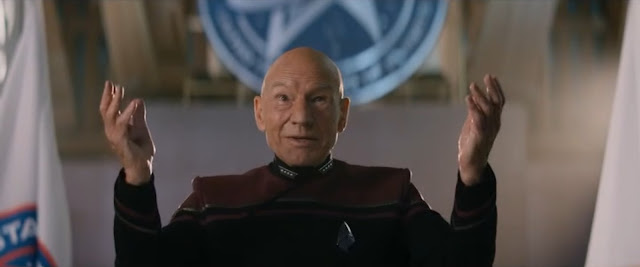
Picard gives a speech about second chances.

THOUGHTS ON SEASON TWO:

Fair warning: This is a look at the season as a whole. If you haven't seen Season Two yet, know that there are spoilers throughout!

I mostly liked Season One of Picard, which felt like a legitimate attempt to do what good science fiction has always done: Used the idea of the future to reflect on the present. The show opened with Picard disillusioned and resigned to a world moving in the wrong direction, with the story gradually bringing him back to his old self over the course of the season.

There were certainly flaws. Not all the characters were well used, and the general idea of a Starfleet suffering from moral decay seemed to vanish midway through. Even if I didn't like every creative choice (such as Picard's synthetic body), I still enjoyed the story and at the very least respected the ambition.

I found Season Two to be more of a mixed bag. It fixes many of the first season's problems, but it replaces them with all new missteps. I found most of it to be entertaining, and even the worst episode remains watchable... but I didn't find the story to be as interesting. In the end, I was left feeling underwhelmed.

But before I explore the reasons for my disappointment, let me start with what the season did well...
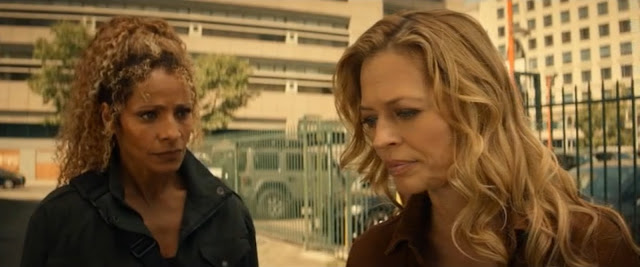
Seven and Raffi struggle to reconnect
amidst an ocean of personal issues.
Seven and Raffi struggle to reconnect amidst an ocean of personal issues.

FORWARD PROGRESS - CHARACTERS:

The cast is much better used in Season Two than in Season One. Every member of the ensemble gets at least a few moments in the spotlight, and the scripts allow them some enjoyable and well-written interactions.

Now, this is likely helped by the early episodes culling a couple of "extra" characters. Soji, the central character of Season One's story, is seen in the first episode just long enough to establish that she's on a diplomatic mission and won't be joining the rest of the characters. Elnor is present for the first stage of the mission, but he gets killed in Episode Three.

I think this was a good choice. Had both characters been retained, they would have just been additional crew members in need of things to do. Removing them makes it more viable to give quality material to the other regulars. Elnor's death also fuels Raffi's character arc, while Isa Briones gets a decent supporting role through the magic of time travel doppelgangers.

I complained about the Season One finale just establishing Raffi and Seven as a couple without having ever shown any interaction between them. Season Two takes this clumsily created relationship and makes it work. Having missed the chance to show their initial connection, the writers do the next best thing. They start the season with them estranged, broken up by the multitude of personal issues each of them has. Then the rest of the season sells them as a couple by showing them overcoming those barriers. It even ties in with the season's theme of revisiting the past. As Picard observes in a graduation speech early on, second chances are rare. Seven and Raffi get one, because although their relationship already failed, their feelings for each other remain.

Finally, there's Agnes Jurati. Despite second name billing and a role in the story that should have made her central, Season One often shunted Alison Pill's neurotic scientist to the periphery. She gets a much stronger role in Season Two. Like Seven and Raffi, her relationship with Rios has failed between seasons, but she is not looking to reconnect. She's alone - and despite an apparent yearning for connection, she seems determined to stay that way.

This not only makes her vulnerable to the Borg Queen's manipulations, it also allows the scripts to thematically parallel her with the Borg. Many of the season's best moments come from this: the connection with the Borg Queen in Assimilation, Jurati's attempts to co-exist with the Queen in Two of One, and her appeal to the Queen in Hide and Seek. Alison Pill is excellent throughout, and she plays particularly well opposite Annie Wersching's Borg Queen.

There's really only one character whose arc didn't work for me in Season Two. Unfortunately, it's kind of a big one...
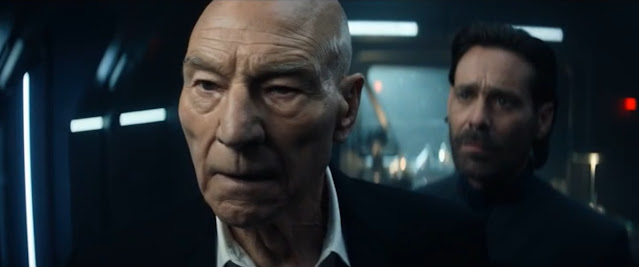
Picard struggles to learn lessons he already learned before.

PICARD'S JOURNEY:

I see what the writers were attempting with Picard. Q takes him and his crew into the past to save the future, while at the same time Picard is forced to confront his own past to overcome emotional issues interfering with his happiness in the present. On paper, it sounds fine, even clever.

Other opinions are certainly available, but I didn't think the execution of it worked at all.

One problem for me is that much of the material regarding Picard's past has no real connection, either in terms of plot or theme, to the external threat he's dealing with. Only Hide and Seek manages to overcome this problem, thanks to Picard using the tunnels from his childhood against the villains. Monsters, on the other hand, resorts to dream sequences/flashbacks that feel thinly motivated at best.

The other problem is that those are the only two episodes that significantly address his past and his need to confront it. This is the basis of his arc, and yet aside from these two episodes it is only occasionally even mentioned. It's hardly surprising that, in a ten-episode season, an arc that's ignored for full episodes at a time doesn't get a chance to properly build.

My final complaint might also be my biggest issue: TNG already trod a lot of this ground, and frankly in better episodes. Picard's strained relationship with his family was at the core of Season Four's Family. There, he (somewhat) mended his relationship with his brother. Here, he comes to realize that his late father wasn't the stern monster of his memory but was actually dealing with considerable emotional pain himself. It's a worthy enough lesson... but I can't escape feeling like we've done this already!

The other lesson Picard must learn is that, however badly he may wish to, he cannot change the most painful moments of his past. Even if he could change them, the results would probably not be to his liking. Again, he's already had this realization - thanks to Q, no less! - in Tapestry. Now, it's fair enough to echo past episodes. Given how much Star Trek was cranked out in the 1990s, some echoes are inevitable. But if you're going to retread old ground, maybe don't make it some of the old series' very best episodes?

For the record, none of this keeps Picard from working as a character the bulk of the time. When the scripts aren't laboring to make him (re-)learn a Very Important Lesson, both Picard and actor Patrick Stewart are a joy to watch. I loved his protectiveness of Jurati, or his wonderfully scripted pep talk to  Renée at the gala. The character was at his best in these scenes, or when ultimately choosing to deal honestly and compassionately with the FBI agent holding him and Guinan prisoner. At the end of Hide and Seek, I almost got chills from his vow not to accept a bad outcome before it happens.

So yes, the character still works splendidly when Picard is simply being Picard: literate, obstinate in ways sometimes good and sometimes not, compassionate, and with the ability to turn hopeless situations to his advantage. Problems only sneak in when the writers try to force him into an arc that fails to convince.
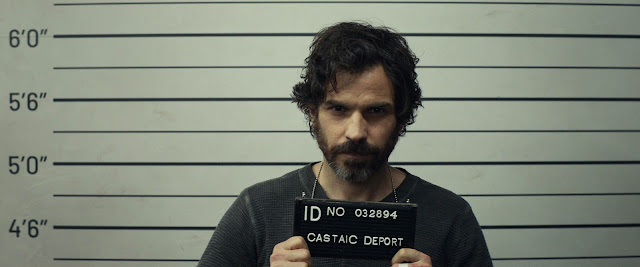
Rios gets arrested by ICE. I'm glad the show has time for this, and that the actual plot won't get badly rushed later on...
Rios gets arrested by ICE. I'm glad the show has time for this,
and that the actual plot won't get badly rushed later on...

A PROBLEM OF PACING:

Season Two opens extremely well. The first three episodes are quite good, and they set up almost everything that the rest of the season will follow.

The opening episode efficiently shows how the characters have progressed since Season One. The bulk of the episode establishes character arcs and relationships. Then, at the end, Picard encounters a crisis involving the Borg, culminating in the sudden intervention of Q. Episode Two expands on Q's role, as he angrily declares that this not a test or lesson, but rather a "penance" for Picard. The rest of the episode follows the character in a dystopian alternate reality. By the end of the episode, we know that this reality is the result of a single change Q made to the timeline in the year 2024. Episode Three brings the characters to their past/our present and starts the main plot moving, while at the same time establishing Rios's relationship with Teresa and drawing parallels between Jurati and the Borg Queen.

The alternate future is a bit of a generic "evil future"; that aside, this opening Act is pretty close to impeccable.

Too bad that the midseason is the opposite of that.

The middle four episodes do an awful lot of water treading. Watcher, my pick for the season's weakest episode, devotes half its running time to pointless side trips. Rios has an extended misadventure with ICE while Seven and Raffi steal a police car and essentially play real life Grand Theft Auto to try to rescue him. None of this even particularly goes anywhere; once Episode Five rolls around, Seven and Raffi rescue Rios with all the effort of pressing a button, and the whole incident receives only a single mention later. A mention that makes Rios look like an imbecile, at that... though the overall treatment of Rios this year makes me wonder if he hit his head really, really hard between seasons.

The final three episodes pick up the pace again. Episodes 8 and 9 see a welcome return to the high quality of the early episodes, and Episode 10 ends by bringing the story full circle with some excellent character epilogues.

Unfortunately, those character epilogues come after some final plot mechanics that are badly rushed. Episode 10, Farewell, opens with Picard and Tallinn trying to stop the villainous Dr. Soong from interfering in the launch of a very important space mission. This should be tense and exciting, with Picard and Tallinn relying on their wits to evade security to beat Soong to the goal while the not-so-good doctor just as desperately tries to bluff his way through using his credentials and attitude. Because it's all crammed into about twenty minutes, though, neither heroes nor villains experience any obstacles. This should be a highly secure area in the midst of enormous activity, and yet we barely even see any evidence of basic staff. Meaning, yes, the pre-launch party was locked down like Fort Knox while the launch itself has less security than a 7/11!

Ideally, this should have been the focus of one full episode, with the character epilogues and resolution of the initial Borg contact left to be an episode in itself. But I guess we really needed that big car chase and that episode about bad dreams, even if it left the actual season climax feeling like a tacked-on afterthought.
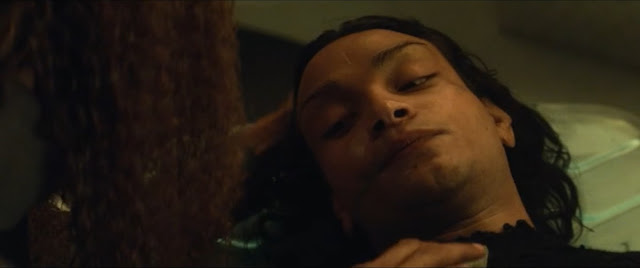
Elnor dies. But don't worry - He gets better.

CONSEQUENCES ARE FOR REDSHIRTS:

Something unexpected happens in Episode Three: Elnor dies. This sends Raffi into a season-long spiral of guilt and anger, with her clinging to the gossamer-thin hope that if they fix the timeline he'll somehow be brought back to life.

I really hoped that the death would stick. Not because I don't like Elnor; I've actually liked the character since his introduction. However, I am a believer that, with only the rarest exceptions, dead characters should stay dead. In my review, I observed that Elnor's death was a vastly more effective unheroic "pointless death" than Tasha Yar's in TNG, and I appreciated the way it was used to kick off Raffi's character arc. I even liked the ways Elnor was used in the later season, with a flashback in Episode Eight and a hologram in Episode Nine developing Raffi's guilt and, finally, resolving it as much as such issues can be.

Then Q brings him back to life in the finale, because why should there be any lasting consequences? I'm reminded of Q Who?, another story in which Q whisked Picard's crew away from familiar surroundings and put them in danger, as the Enterprise experienced its first contact with the Borg. Eighteen crew members died. When an outraged Picard confronted him about that, Q responded perfectly:

"It's not safe out here. It's wondrous, with treasures to satiate desires both subtle and gross - but it's not for the timid."

But it turns out that Mr. Magic will resurrect the dead - provided they are people close to Picard and provided Q is in a sufficiently sentimental mood. So Elnor gets to live! But it sucks to be one of those eighteen redshirts.

The hilarious thing? I'm pretty sure Elnor isn't in Season Three, so there wasn't even a contractual reason to do this. With regard to the larger series, the resurrection appears certain to end up being less than pointless. And had the group been remembering Elnor in that final scene with Guinan, I think it would have been considerably more effective.
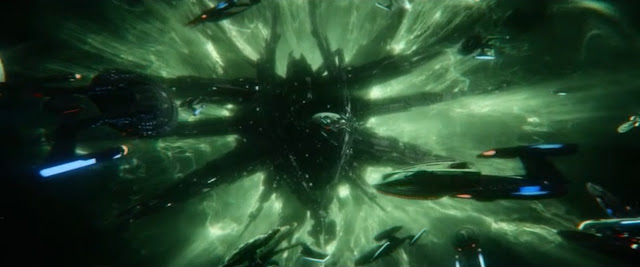
Starfleet faces a threat that isn't exactly as it seems...

SEASON THREE WISHLIST:

As was true when I made up my "Season Two Wishlist," I'm not going to pretend not to know what was in every single promo for Season Three. I already know that Season Three is, to all intents and purposes, TNG Season Eight.

This is not my preference. One aspect of Picard I've consistently appreciated is that it's balanced nostalgia against being its own series with its own set of regulars. I would have preferred that the series continued doing that. Yes, I enjoy guest appearances by members of the old cast where appropriate - but I would have liked them to remain guest appearances.

Still, the producers made their choice, and overall reception to Season Three indicates that it was the correct one for a lot of fans. Knowing that, my main hope is that the characters are properly utilized. Let's not repeat the mistake of Enterprise's These Are the Voyages, please, in which years had passed but all the characters were still exactly the same. It's been a long time. I hope the show acknowledges that by showing that the characters have moved on in various ways in the interim.

I also hope that the background set up by Picard's first two seasons is not forgotten. Synthetics are now a part of the Federation, though that has come after more than a decade of their mere existence being outlawed. This is an issue that deserves some follow-up. Picard has a synthetic body, which received only a couple of references during Season Two. I don't expect any meaningful follow-up, but I consider the lack of follow-up to have been a missed opportunity. There have been references to a mysterious threat in both seasons, and that absolutely should be addressed.

But my biggest hope is just that Season Three is good. Season One had plenty of flaws, but I liked it overall. I found Season Two to be a bit disappointing, but I still enjoyed more of the episodes than not. In all likelihood, Season Three will be the last time we ever see all of these characters together again, much as was true of Star Trek VI and the TOS cast. As such, I hope it follows in Star Trek VI's footsteps by delivering a final adventure that's worthy of them.

If nothing else, it's almost certainly going to be better than Nemesis. And I say that as someone who mostly liked Nemesis on its own terms.
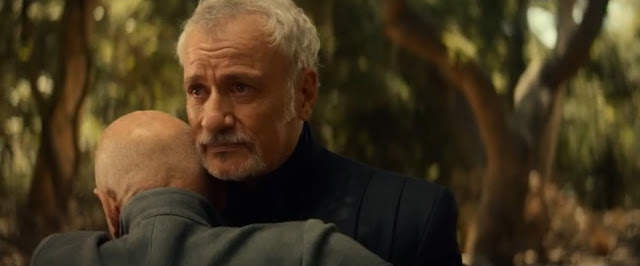
Q and Picard say farewell.

IN CONCLUSION:

"Potential" was my keyword for Season One of Star Trek: Picard. The season was swimming in interesting ideas, intriguing elements, and enjoyable characters. It didn't always use them as well as I'd have liked, but it was clear that there was the foundation for a legitimately interesting series that went beyond just "TNG nostalgia."

Unfortunately, my keyword for Season Two is "disappointment." I don't think Season Two is bad in the way its worst detractors insist. There are several good episodes and a few very good ones, and even the weakest entries remain watchable (something that wasn't always true of TNG). But the whole ended up feeling like less than the sum of its parts, and I came away feeling... honestly a little discouraged by it.

I'm hopeful that Season Three will stick the landing, and will manage to do so in a way that fits Star Trek: Picard and not just Star Trek: The Next Generation - Reunion. But I have to admit that, even though I enjoyed it well enough on an episode-by-episode basis, Season Two has left me feeling just a bit hollow.


Previous Season: Season One
Next Season: Season Three

Review Index

To receive new review updates, follow me:

On BlueSky:

On Threads: