Showing posts with label Romulans. Show all posts

Wednesday, July 20, 2022

Thoughts on Season One.

Admiral Jean-Luc Picard (retired) uncovers a conspiracy...

Star Trek: Picard was a highly awaited show. Boasting the return of Patrick Stewart to an iconic role, and with award winning writer Michael Chabon in charge of the story, the series promised much. Pre-release promotion indicated that the series would offer storytelling that was intelligent and adult, while still providing plenty of fast-paced action for genre fans.  Basically, Picard would satisfy old-school fans and new ones alike.

That was probably always going to be a tough promise to live up to, so it's little surprise that the results were a bit... mixed.


"NO LONGER STARFLEET":

Though the series' premiere suffers from uneven pacing, there is much promise in the initial episodes. Science fiction generally is written as a reflection of modern society.  That's very much the case here; released in a divided time in which many feel pessimistic about the future, Picard presents a decaying Federation that is moving in the wrong direction.

The series opens with a sense of disillusionment. Picard has renounced Starfleet, condemning them for turning their back on their own ideals. "They were no longer Starfleet," he angrily proclaims during an interview. When he later goes to a Starfleet admiral for help, she throws that interview back in his face and tells him that Starfleet "is no longer your house," all but dismissing his concerns as the fantasies of a senile old man.

The first half of the series follows up on this. Absolute Candor shows us the Romulan refugees left to fend for themselves after Starfleet decided not to continue lending aid to their one-time enemies. The contrast between the hopeful refugees shown in an opening flashback and the bitter, angry ones seen in the present brings home the consequences of this. Even Stardust City Rag - the season's most standalone episode - reintroduces a Seven of Nine who has joined a vigilante outfit to try to keep some semblance of order in territories that Starfleet abandoned.

Romulan refugee Ellnor resents Picard for abandoning him.

A DROPPED THREAD:

This is an interesting thread, even just as a background to the main action. Unfortunately, it's all but completely dropped midway through the season.

The second half of the season barely references the changes in Starfleet since the TNG era. Only Broken Pieces remembers it, and then only long enough to tie up some plot issues. Other than that, this might as well be the Starfleet of the 1990s series. In that same episode, the previously dismissive Admiral Clancy promises Picard her support, and neither Picard nor his crew ever seem in any doubt of it. The finale then sees Starfleet represented by the friendly face of William Riker... which oddly echoes Star Trek: Insurrection, in which Riker also secured a reversal of a prior Starfleet decision entirely off screen.

I would have preferred the series to have kept alive the idea of a Starfleet that Picard couldn't necessarily count on. As much fun as Riker's cameo in the finale was, it might have been more interesting if Starfleet had arrived at the android planet with the same goal as the Romulan fleet: to try to curtail a threat. Then Picard could have been left trying to negotiate with three potentially hostile parties: the androids, the Romulans, and Starfleet. That might not have left much time for climactic action scenes... but it would have been more of a piece with the start of the season.

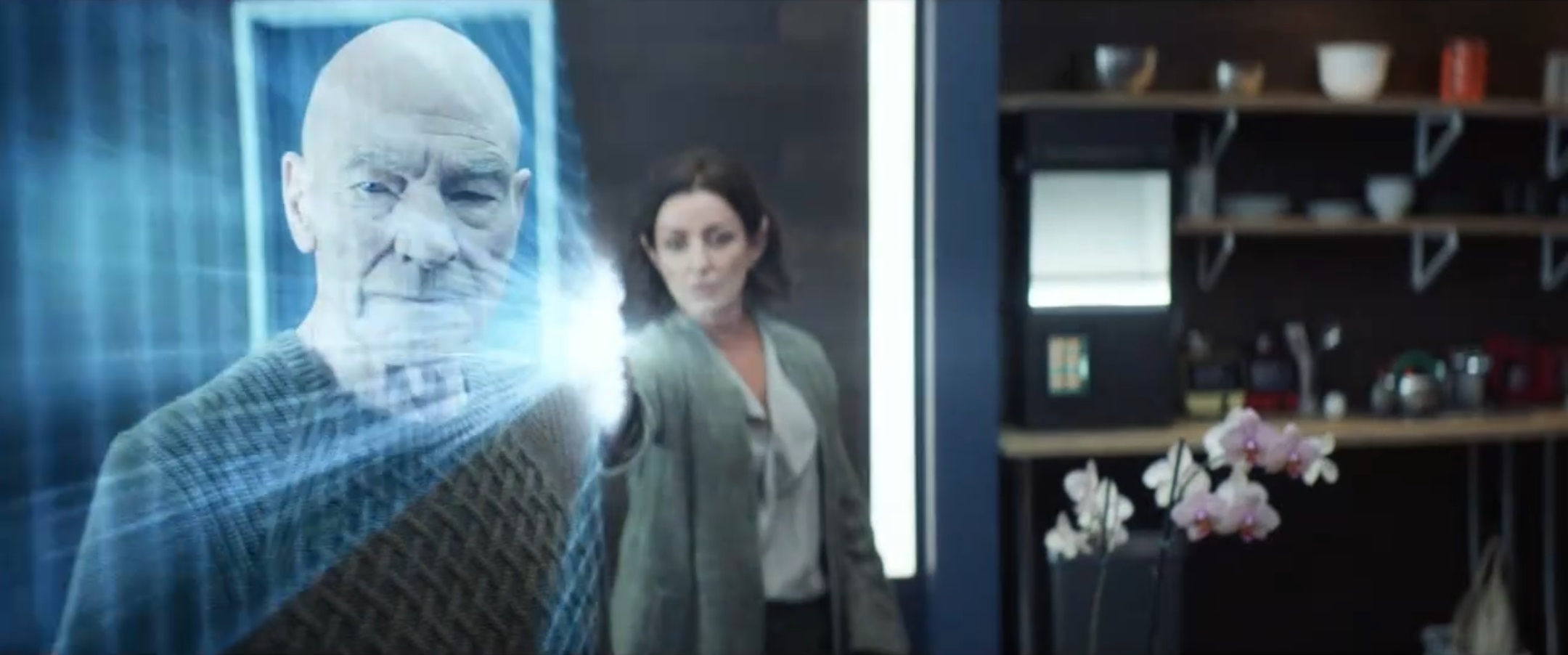
Picard visits old colleagues Will and Deanna Riker.

AN EFFECTIVE BALANCE OF STORYTELLING AND NOSTALGIA:

The greatest strength of Star Trek: Picard's first season is in how well it manages to feed nostalgia for the TNG era while still retaining its own identity as a very different series.

The series' opening scene features Picard playing poker with Data on the Enterprise - spiritually picking up exactly where the final scene of TNG's finale left off. It quickly becomes apparent that this is a dream sequence, and Picard is left waking up to his current life and situation, which is very different than his days as a starship captain.

The next several episodes focus on furthering the season's story and on introducing the new characters. These characters work well for the most part. Santiago Cabrera's Capt. Rios emerges as the standout; but all of the new regulars are well-played, and every character gets at least a few good moments throughout the season.

Even as Picard develops its new cast, it continues to drip-feed nostalgia from 1990s Trek. Episode Two references Picard's former crew members and explains why he won't just turn to them for help. Episode Four ends with the return of Seven of Nine, arguably the most popular character from 1990s Trek series Voyager. Episode Seven, Nepenthe, plays the most directly to TNG nostalgia, with Picard visiting old colleagues Riker and Troi and spending an entire episode as their houseguest.

This last should be a complete momentum killer, an episode-long wallow in nostalgia. However, the script makes it work. Not so much in the cutaways to Rios and the other crew members, whose scenes mostly feel like an intrusion - but in the primary material, with Picard, Soji, and the Rikers. Though these scenes have a pleasantly relaxed atmosphere, the focus remains on Picard's efforts to gain the trust of the traumatized android Soji. By putting story and much character emphasis on Soji's trauma and her wariness of Picard, the episode manages to balance the demands of being the fan-pleasing "Riker/Troi episode" against those of being a part of this series.

Picard has a conversation with Data that sums up the season's themes...
just in time for the rest of the episode to undermine it.

THE ENDING (YES, SPOILERS IF YOU HAVEN'T SEEN IT):

While Picard's finale was far from perfect (Example: Seven's plotline ends with her having a catfight against a character she never previously met, in order to avenge a character with whom she never shared a second of screen time), it was satisfying overall, particularly with regard to Picard's character journey. The man who had started the season as a bitter shell of his former self ends it making an impassioned plea about the responsibilities of being alive. He does this fully expecting it to be his last act, and it is a fine ending to his season journey. Had this been Picard's end, it would have been a substantially more fitting than the one Kirk received.

Then the last 10 - 15 minutes wrecks it by transferring Picard's brain into an android body.

It's not that there isn't dramatic potential in this. Earlier in the season, we see again the scars of Picard's assimilation by the Borg. He almost collapses when he beams onto The Artifact, the dormant Borg Cube claimed by the Romulans. He admits to Seven that he's never felt 100% human again after his experience of being Locutus of Borg.

In short, this should be Picard's greatest horror come to life: He is now something not quite human. Entirely without his consent, he has been "assimilated" by Dr. Soong. And there might be potential in that, except... the ending downplays this entirely. It's spelled out in painful detail that Picard is entirely unchanged. He's exactly as he would have been, with exactly the remaining life span he would have had, minus the terminal disease that's been hanging over him all season. And Picard is entirely OK with it, voicing not even a single reservation.

The whole thing feels like a cheat. Not only does it cheapen the sacrifice Picard was willing to make; it undermines the sentiments Data made just one scene earlier, in which he notes that the value of life is that it ends and that "a butterfly that lives forever is really not a butterfly at all." The entire structure of the season was that this was Picard's last adventure, and he explicitly states that he's giving his life to Soji and her people. By reversing that sacrifice so clumsily, it undermines much of what went before.

Narek manipulates Soji in the season's best episode.

THE CURSE OF A TEN-PART MOVIE:

To an extent, many of my issues with the season have to do with the structue of most modern series, particularly those made for streaming. Star Trek: Picard is less a television series than it is an elongated movie. Like a movie, most of its efforts go to furthering its central plot - one main plot that covers the entire season.

There are a couple breaks from this. Absolute Candor focuses on the displaced Romulans. Stardust City Rag comes close to being a standalone, centered around a sting against a dangerous criminal. But those are the only two exceptions. The rest of the season is centered around Picard's efforts to save Soji (and later, her people) from the Romulans.

I recognize that this kind of long-form storytelling is one of the advantages television has over movies. Stories can cover more ground, involve more characters, and deal with more complexity than can be fit into a 2-hour movie. At times, Star Trek: Picard makes this work. The Impossible Box, in which the various threads finally come together, is an excellent episode, easily the season's best, and its success comes in large part from it being able to pay off what was set up by previous installments.

However, I worry that the focus on long-form storytelling has led to neglect of television's other advantage: Its ability to pause and tell stories that are intimate, personal, and even small. This is far from a fault unique to Picard - but when everything is focused on showing some large-scale epic, then there isn't time for people sitting in a room talking, working through a conflict or a moral quandary in a quiet, contemplative manner.

I enjoyed (most of) Picard. But I didn't award a single "10," and I can't help but wonder if part of the reason is that everything had to fuel the plot. I think back on some of my favorite past Star Trek episodes, and so many of them are unimaginable in the framework Picard has employed. I can't imagine this series ever having room for episodes such as: Tapestry, The Inner Light, Duet, The Visitor, It's Only a Paper Moon, or Mortal Coil.

Again, that's more a comment on the trend of shows in general - but if there's no longer room for small, quiet storytelling gems, then I'd argue that more has been lost than has been gained.

Picard, back in command.

SEASON TWO WISHLIST:

Given that Q was in every promo for Season Two, I'm not going to feign total ignorance of what's to come. I know that Q will return, and I know that the next season will deal with some alternate universe shenanigans. I've managed to remain unspoiled beyond that.

My biggest hope is that they take what I felt was a disastrous ending and turn it into an asset.  I do not want to see it overwritten - Please no "Q handwaves it away" solution.  Instead, make use of it.  I still feel that Picard should be greatly troubled by what was done to him.  Take as a starting point that Picard, who has stated that the Borg left him feeling less than fully human, now actually is other than 100% human.  I don't like that it was done; but since that route was taken, I hope they follow it and make something interesting out of it.

I also hope that they continue to make good use of the regulars they have established. I actually quite like Picard's cast. Even the underused characters have potential, and all of the actors are at least competent. I'd love to see more of Picard's ex-Tal'Shiar housekeeper from the first three episodes; the actress was terrific, and I was actively disappointed when she didn't return later in the season.

I would also love for the series to revisit the idea of a Federation that has gone slightly wrong. That was one of the strongest elements of the season's first half, and I feel it was a major missed opportunity to drop that thread for the second half. If they could pick that thread back up and do something with it, I think it could be potentially interesting.


IN CONCLUSION:

"Potential" is a word that comes to my mind a lot when thinking about Picard's first season. There was a lot of potential here for a fine show. Unlike some, I found this to be an enjoyable season; I'd rank it above at least three seasons of TNG (and I think Trek fandom sometimes forgets how uneven much of TNG really was).

That said, this season only occasionally realized its potential. The ideas were present for Season One of Picard to be a remarkable piece of television, and there are glimpses of that in Maps and Legends, The Impossible Box, and Broken Pieces. The rest of the time, however, the series contented itself with being merely serviceable.

It was still better than three of the four TNG movies, mind you... But I'd like to see that bar set just a bit higher than that.


Next Season: Season Two

Review Index

To receive new review updates, follow me:

On BlueSky:

On Threads:

Tuesday, June 28, 2022

1-10. Et in Arcadia Ego, Part 2.

Picard, in command of La Sirena, prepares to confront a Romulan fleet!

Original Air Date: Mar. 26, 2020. Written by: Michael Chabon. Directed by: Akiva Goldsman.


THE PLOT:

The end is nigh.

Sutra's deception has succeeded: Soji, Soong, and the androids are all in agreement about sending the signal encoded in The Admonition. This will result in the summoning of advanced synthetics who will save the androids... at the expense of all organic life!

Narek has a plan. He sneaks into the Artifact to recover enough explosives to destroy the transmitter. Knowing he can't succeed in this effort alone, he appeals to Rios, Raffi, and Elnor for help - though Elnor seems as inclined to kill him as listen to him.

Meanwhile, Jurati breaks Picard out of confinement. Just as Oh (Tamlyn Tomita)'s Romulan fleet arrives, Picard tries a gamble of his own - a final bid to stop the Romulans and to prevent the synthetics from transmitting their deadly message!


CHARACTERS:

Picard: "I am trying to pilot a starship for the first time in a very long time, without exploding or crashing!" One thing the finale gets right is Picard himself. While Rios and most of the crew try to stop the signal, Picard launches into orbit in La Sirena with only Dr. Jurati to assist. This brings Picard full circle: Gone is the bitter old man from the winery, and in his place is the confident Starfleet captain. "The Picard Maneuver" is even utilized to catch the Romulans' attention to delay their attack - well, a significantly enhanced version of it. Patrick Stewart is marvelous, as always, and it's appropriate that the finale centers in large part around him making a plea relying on reason and morality - always Picard's greatest tools - rather than relying on threats and brute force.

Riker: As with Seven of Nine's first appearance at the end of Absolute Candor, I feel Jonathan Frakes's billing should have been reserved for the end credits to preserve the surprise. But since they slap "Special Guest Star: Jonathan Frakes" right on there, I'll observe that Riker gets a decent supporting role, in a way that effectively follows up on his scenes with Picard in Nepenthe, with Riker's ongoing support for and belief in his old C. O. coming through strongly.

Data: The season opened with Picard dreaming of Data, and it closes with a fully conscious Picard speaking to Data thanks to a computer simulation. Brent Spiner's age is visible despite the best efforts of the makeup crew (and likely some CGI enhancement), but the scene is a nice touch, the two men speaking thoughtfully about the value of mortality. Though I wasn't particularly upset with Data's original sendoff, this quiet conversation, followed by a moment in which Data listens to Blue Skies (the song he sang at Riker's wedding) is a far more appropriate final bow for the character.

Dr. Soong: Data's curtain call does not spell the end of Spiner's Star Trek involvement, not so long as the Soong dynasty continues to have every male member look exactly like him. Alton Soong is appalled when he learns that Sutra helped Narek not only to escape, but to kill one of her own sisters to push the androids into sending the signal. "Turns out you're no better than we are," he says, the disappointment heavy in his voice. I hesitate to call this a redemption; Soong was entirely willing to commit genocide until he found out that his "children" are just as capable of selfishness and deception as all other sentient beings. He may end up being not quite a villain... but I find myself ultimately agreeing with Picard's assessment, when he states, "I don't much care for him."

Soji: Her encounter with Narek in the previous episode really should have been better written, as its apparent that their conversation in conjunction with Sutra's deception has pushed her into activating the signal.  She's the target of Picard's plea, and she is also the ultimate target of Oh's planned attack, meaning that the entire resolution revolves around her choice. Since we're never in doubt as to what she'll do, the stakes revolve more around the character than the plot. Unfortunately, in this episode, Soji feels more like a plot device than a person, leaving all of our character investment purely with Picard, which blunts the effectiveness of an otherwise generally well-executed climax.

Dr. Jurati: It turns out that she was lying when she pretended to be on the side of Sutra and Soong. When Soong congratulates her on the "sacrifice" she is willing to make as the androids' "mother," Jurati smiles and nods... until he leaves, when she spits out, "I'm not their mother, asshole." The endearing geek-girl side of her, seen in her Episode Three grin when Picard said, "Make it so," pops up again as she breaks Picard out, all the while amazed that no one has detected "the worst secret agent ever." Alison Pill, who's been too often pushed to the sidelines, seems to revel in her meatier role this episode. Still, I can't help but wonder at how all of her actions from the mid-season seem to be completely forgiven (even forgotten) by the ending scenes.

Narek: Thankfully, the one-dimensional pod-Narek of the previous episode is gone. Once he sees the transmitter, Narek is smart enough to go to the La Sirena crew to urge a truce to try to stop what is coming. Just as refreshingly, both Rios and Raffi are entirely willing to listen to him. They're wary, but they listen, and manage to form a plan to get back into the compound.

Seven of Nine: Her role in the finale is... underwhelming. I expected that she would be working to get the Borg's defenses back online to help in stopping the Romulans. This does not happen. Instead, Seven participates in the climax by getting into a fight with Narissa (who returns, both inexplicably and unnecessarily, after having been seemingly dispatched at the end of Broken Pieces). This entire bit feels like something spun out of whole cloth just to give Seven something to do. Much better is her final conversation with Rios, which reminds us that Jeri Ryan is actually a very good actress, something I hope Season Two makes better use of.

Oh, and perhaps following in the tradition of Voyager (which apparently ended with her in an inexplicable relationship with Chakotay), a shot near the end implies a new romantic relationship... with a character opposite whom she has barely shared screentime! I'll reserve judgement on this until I see it play out - but I can't help but wonder why this development wasn't saved for Season Two, when there might have been time to lay groundwork for it.


THOUGHTS:

"Fear is a poor teacher."
-Admiral Jean-Luc Picard, retired.

The entire crisis of Et in Arcadia Ego, and of Picard's first season in general, is because of fear. The Zhat Vash's entire existence traces back to fear of synthetics. That led them to sabotage Picard's rescue mission - of Romulus, no less - which in turn led to Starfleet banning synthetics... an overreaction born out of fear. Actions taken by both Starfleet and the Romulans have led the synthetics to feel backed into a corner, ready to lash out from fear of their own annihilation, in an attitude of "it's us or them"... a reaction that, as Picard observes, will make them into the very destroyers the Romulans have prophesied.

Picard has no capacity to go toe-to-toe with the Romulans, let alone the unknown synthetics. He has one ship against hundreds. Oh's initial reaction to La Sirena is to ignore it. Picard instead uses his wits to draw the Romulans' attention, all to delay the bombardment long enough to get Soji to listen as he pleads with her to make a better choice.

Related to the theme of fear throughout the season, we have also witnessed characters justifying their actions by claiming they have "no choice." Dr. Jurati felt she had no choice but to murder Bruce Maddox. The Zhat Vash insist they have no choice but to do whatever is necessary to stop the synthetics. Rios's former commander was ordered to commit murder, given no choice if he didn't want his own ship to be destroyed.

When Soji claims that she has no choice but to send the signal, Picard rejects that excuse. He labels it "a failure of imagination," and tells her that the decision to become the destroyer or not is what it has always been: Soji's decision and responsibility, and no one else's... in the process implicating every cry of "no choice" that has been heard throughout the show.

All of this works thematically, the refrains of fear and people feeling they have no choice having built throughout the season. It also works in terms of the story. As an episode, Et in Arcadia Ego, Part 2 builds effectively. Act One establishes the transmitter and the stakes. We then follow two groups - Narek and the La Sirena crew, Picard and Jurati - as they undertake separate actions to try to stop it. The final Act pays off the conflicting issues of the season - not only with the Romulans arriving, but with Picard trying to stop them with an appeal to reason and morality based largely on his own hope and faith in others... showing his own restoration, as such hope and faith would have been far beyond the broken man we saw in Remembrance.

For 45 of its 57 minutes, Et in Arcadia Ego, Part 2 stands as a strong season finale. Not everything works (the Narissa/Seven catfight is as poor as it is superfluous) and there's a bit too striking a resemblance between the glimpse we get of the Doomsday Synthetics and Babylon 5's Shadows (not quite enough to be a copyright infringement, but enough to make me skeptical of coincidence). Still, it's engaging and effective, with the quiet conversations between Rios and Seven, Elnor and Raffi, and finally Picard and Data all serving as an effective button...

And then the ending happens.

If you haven't seen the episode, then stop here, because I don't know how to discuss the ending without spoiling it...

A final conversation between old friends.

A MISJUDGED EPILOGUE

"A butterfly that lives forever is really not a butterfly at all."
-Data inadvertently sums up some of the problems with the ending.

Another theme the episode develops is the value of mortality. In the wonderfully effective Data cameo, Data makes a plea to have the matrix sustaining his intelligence shut down, so that he can experience a life that ends.

This fits with Picard's own arc. He has spent the entire season knowing that his time is short, that this will be his final mission. When he launches into orbit to face the Romulan fleet, he knows it is a one-way trip. He states that he is doing this to offer his life to Soji and her people, in hopes that they will see that they have options other than destruction. When he starts to collapse, he has Jurati inject him with stimulants that aggravate his condition, all so that he can remain alert to make his last appeal. To make his death mean something.

...And then they undermine that entire message by turning Jean-Luc into a frickin' robot!

Yes, Picard's consciousness is transferred into the synthetic "golem" that has been set up for the past two episodes. Even this isn't used effectively. This should frankly horrify him: His worst nightmare is being made into something other than human, as happened with the Borg. Instead, he's assured that everything is fine - He's basically entirely as he would have been minus the terminal illness, nullifying any chance of wringing anything more out of this late development. To all purposes, Picard having his brain put into a new body is nothing more than the most convoluted cure for a disease in recorded history.

This feels like a cheat, because it is a cheat.

Far, far better had the episode ended with Picard's death, with his consciousness fading during that conversation with Data and a tag featuring the other characters' reactions. But then I guess we couldn't have a Season Two. And what's thematic unity compared to keeping the cash cow pumping?


OVERALL:

For all that the ending leaves a bad taste in my mouth, I still have to give Et in Arcadia Ego, Part 2 a good score. For the bulk of its running time - and the entirety of the actual plot - it's highly engaging. The character dynamics are good, and the season's themes are effectively dramatized.

It's a shame about that epilogue, and I'd almost advise hitting "STOP" at the end of the scene with Data. Much like the season itself, however, the flaws of the episode - while evident - aren't enough to keep me from considering it a worthwhile addition overall.


Overall Rating: 7/10.

Previous Episode: Et in Arcadia Ego, Part 1
Next Episode: The Star Gazer

Season One Overview

Review Index

To receive new review updates, follow me:

On BlueSky:

On Threads:

Tuesday, April 5, 2022

1-04. Absolute Candor.

Picard solicits the aid of Elnor (Evan Evagora), who was trained by a Romulan warrior sect.

Original Air Date: Feb. 13, 2020. Written by: Michael Chabon. Directed by: Jonathan Frakes.


THE PLOT:

Picard takes a detour to Vashti. During the Romulan evacuation, Vashti was the planet where refugees were housed to await permanent relocation. After the synthetic uprising, the evacuation was abandoned, as were the refugees... leaving Vashti to degenerate into a crime-riddled slum.

Picard tries to enlist the aid of an old friend: Zani (Amirah Vann) of the Qowat Milat, an order of Romulan warrior nuns who believe in "absolute candor" - always speaking what they are thinking and feeling. Years ago, Picard had befriended Zani's ward, a refugee boy named Elnor (Evan Evagora). Now a young man, Elnor harbors resentment at Picard's abandonment of him. Zani requests Picard take Elnor with him on his mission, assuming Elnor can overcome his anger long enough to agree.

Meanwhile, Soji searches for answers about what happened to the Romulan ship assimilated by the Borg. Narek indicates that he may be able to get those answers.  Soji, however, finds herself increasingly wary of her lover's secrets, even as his information leads her to begin doubting herself.


CHARACTERS:

Picard: Goes to Vashti for two reasons. The first is practical: He knows that he and his ramshackle crew are up against dangerous forces, and having a trained Romulan warrior on his side will be a benefit. The second, and more important to him, is emotional: He feels deep guilt at his failure to complete the evacuation. At the time, he solely blamed Starfleet, telling Raffi that it was impossible to evacuate everyone without Starfleet support. Now he blames himself for not attempting to do something more, acknowledging to Zani that even though he couldn't save everyone, he should have done everything in his power to do more.

Soji: Her conversation with Ramdha has left her feeling driven to understand more. We first see her watching an old interview with Ramdha, from before the Borg, in which she described the mythological significance of "The Destroyer" - the name she applied to Soji. When Narek appears, seemingly out of nowhere, Soji expresses suspicion about how he always seems to know where she is or what she is doing. She remains drawn to him, as we see at the end of a sequence in which they playfully evade security sensors only to fall, laughing, into each others' arms, but she doesn't trust him.

Capt. Rios: Though he seems to be the Star Trek version of Han Solo, the jaded mercenary pilot with the beat up but highly maneuverable old ship, there are clearly other sides to him. When Jurati catches him on his down time, he is doing some light reading: a (paper) book about the implications of man's awareness of his inevitable death. He seems to instinctively defer to Picard, but he still bristles when Picard snaps orders before he does.

Dr. Jurati: Now that the mission is underway, Jurati takes on the role of Audience Surrogate, voicing the observations that most of us would have in the same situation. She finds space travel boring, because there's really nothing to do until they reach their destination. When Picard and Raffi describe the Romulan warrior nuns, she can't help but grin about such an Order actually existing. Even so, she opines that the Order's "Way of Absolute Candor sound potentially annoying."

Elnor: Evan Evagoria debuts as Elnor, whom I sincerely hope is the last of the series' "new regular" introductions. As a child, he is enthusiastic, swiping fruit from the local market, begging Picard to read to him, and clearly engaging in some serious hero worship toward the Starfleet admiral. 14 years later, that hero worship has turned into bitter resentment. When Picard asks for his aid, he snits that the old man has only come to him now that he can be useful, and his first inclination is to turn him down flat. It's no spoiler to say that he changes his mind, in a scene that demonstrates both his combat skills and his lack of restraint in a single blow.

Narek: He plants "a seed of doubt" in Soji, telling her that despite her memory of traveling on the Ellison to the Beta Quadrant (where the Borg Cube is located), her name does not appear on that ship's manifest. When Soji demands to know what game he's playing, he replies honestly by his standards: "Feeding an insatiable curiosity." His sister later observes that his obsession with Soji makes sense, given that he's been studying androids for his entire life.


THOUGHTS:

Before I discuss the episode proper, one quick complaint. Absolute Candor is the second Picard episode in which a character has dropped an "f" bomb, seemingly for no reason other than to show that they can. I'm happy to see modern production values and storytelling techniques in use in this show; I don't want new Star Trek to look and feel exactly like old Star Trek. But for all that... the "f" word feels out of place to me in Star Trek. It doesn't offend - I just find it jarring, and it takes me momentarily out of the episode.

That aside, I enjoyed Absolute Candor. Not least because, while it's still very much a stage setting episode, it is the first installment to really have its own individual focus: namely, Picard's return to Vashti, and the guilt he feels as a result.

"A promise is a prison," Zani intones early in the episode, during Picard's previous visit to Vashti. We open (once again) 14 years in the past, with Admiral Picard dropping in on the Romulan refugees. He is greeted as a hero, and he isn't shy about playing the part as he makes promises about Starfleet's support. His stay is cut short by news of the synthetic uprising. When Zani asks what impact this will have on their efforts, Picard makes one last promise: That all will go ahead as planned. It's a promise he won't be able to keep.

His return to Vashti shows how far the planet has fallen. It's physically the same, though the golden lighting of the opening is replaced by a flat, ugly visual aesthetic for the present. The main difference, however, is in the residents. When Picard beams down and greets the people on the streets, they don't reply. Most don't even look at him; those who do, stare in a way that's decidedly unfriendly. And establishments now are marked with signs reading: "Romulans only," underscoring inter-species tensions that had not been there previously.

This change is a direct result of Starfleet pulling back their support. The evacuation was called off, and Vashti was left to its own devices. Picard feels instant guilt. He may have argued against Starfleet's decision. But after Starfleet decided, he... did nothing. As he admits to Zani: "I made the perfect the enemy of the good."

That the episode is focused around Vashti, and Picard's emotional ties to the planet, helps it to feel more like a full episode than like just another chapter. The individual story - Picard's return to Vashti and his recruitment of Elnor - is simple, but it's effectively done, all the more so for the contrasts between past and present: The vibrant Vashti becomes a slum; the grateful residents become resentful inmates; and the confident Picard becomes a regretful old man. Patrick Stewart is particularly good here, conveying Picard's guilt without overplaying it or allowing it to compromise his basic dignity.

The episode ends with a crowd-pleasing appearance that would have been a nice surprise... if only the opening credits hadn't spoiled it. Generally, other shows have handled such appearances by saving the actor's credit for the end titles, which is what should have happened here. Instead, when the crew of La Sirena begins talking about a mysterious pilot, we're several steps ahead regarding that pilot's identity. A minor missed opportunity, but I would have much rather been surprised.


OVERALL:

Absolute Candor gets a boost by actually feeling like an episode in itself rather than just a building block. I'm still waiting for Star Trek: Picard to finish stage setting and get on with the play... but the show is keeping me engaged so far, and I found this a solidly enjoyable installment.


Overall Rating: 6/10.

Previous Episode: The End Is the Beginning
Next Episode: Stardust City Rag

Review Index

To receive new review updates, follow me:

On BlueSky:

On Threads:

Saturday, March 19, 2022

1-02. Maps and Legends.

Picard and Laris search Dahj's apartment for traces of her attackers.

Original Air Date: Jan. 30, 2020. Written by: Michael Chabon, Akiva Goldsman. Directed by: Hanelle M. Culpepper.


THE PLOT:

Dahj (Isa Briones) is dead, killed in front of Picard's eyes by Romulan agents. Killed while trying to save him, even though he was meant to protect her.

With few immediate leads to act on, Picard and Laris (Orla Brady) - his housekeeper, also a former member of Romulan intelligence - investigate Dahj's apartment. It's been wiped clean, but Laris finds a few traces of Dahj's sister. Not enough to locate her, but enough to show that she is not on Earth.

Soji (Isa Briones) is a scientist working at the Borg Reclamation Project, a Romulan-controlled facility operating out of an abandoned Borg Cube. Soji's focus is on the removal of implants from Borg drones. She takes her work seriously, regarding it as a duty to free them... but off-hours she is quite playful with her new lover, Narek (Harry Treadaway), a recent arrival who keeps himself shrouded in secrecy.

Meanwhile, Laris informs Picard of the existence of the Zhat Vash, the unofficial, supposedly mythical organization behind Romulan Intelligence organization. The "scrubbing" of Dahj's home leads Laris to believe the Zhat Vash is not only real, but active on Earth. And if Dahj has a sister, that means that the Romulans' work is far from over!


CHARACTERS:

Picard: His on-air denunciation of Starfleet comes back to bite him when he tries to request a ship from Admiral Clancy (Ann Magnuson). Clancy is dumbstruck at the "sheer f***ing hubris" of Picard to ask for favors after shaming Starfleet on interstellar television, and all but tells him to go rot in his decrepitude. Picard, not deterred, draws on other contacts to get into space. When it's pointed out that he will need a crew, he waves off the suggestion of his old shipmates. Data died to save him, and he's been haunted by that for twenty years; he won't put any of his old friends in a similar situation if he can help it.

Soji: The script takes care to make her instantly likeable. When she sees new arrival NaƔshala (Chelsea Harris) worrying about working on the Borg Cube, she puts her at ease with reassuring comments and makes sure to keep close during the woman's first day. She also teases Narek for his secrecy in a way that's endearing without seeming mean. Basically, the episode makes sure to make us invested in her well-being so that we'll care when the plot catches up to her.

Narek: Is so obviously a spy that it would have been more surprising if he hadn't turned out to be one. He's on the Cube to draw information from Soji, which he believes is best done with a gentle touch, and he's not above enjoying his work. He is displeased when he's advised that he needs to get results soon, however - and even more displeased when he's not-so-subtly threatened.

Laris: Thus far, I am absolutely loving Orla Brady's Laris. There are shades of DS9's Garak in the character: a former spy now engaged in a seemingly benign job. She isn't a female Garak clone, though. Garak was cold and calculating; Laris is warm and fiercely protective of Picard. Both fence with their Federation counterparts with humor, but Laris's banter is more friendly, even flirtatious. Though she proclaims Picard's plans to return to space are madness, you can see that she enjoys investigating Dahj's apartment and uncovering secrets, as if she's coming a little more to life herself in doing so.

Pompous Earth Bureaucrat of the Week: Admiral Clancy, presented as the soulless face of a Starfleet that has lost its way. She not only refuses Picard's request, but seems to take pleasure in belittling him. Her attitude aligns with that of the previous episode's interviewer: that the Romulans were their enemies and should have ben left to die.  When Picard protests, she directly states that the Federation "absolutely" gets to decide if other species live or die. She tells him that Starfleet "is no longer (his) house... go home," brushing aside his warnings of a larger plot as the ravings of an old man who is "desperate to matter."


THOUGHTS:

"Before the Tal Shiar, there was the Zhat Vash... a term sometimes used to refer to the dead, the only reliable keepers of secrets... That's the sole purpose of the Zhat Vash: To keep a secret so profound and terrible just learning it can break a person's mind.
-Laris fills Picard (and audience) in on the apparent villains of the season.

Maps and Legends opens with a flashback. Remembrance told us about the synthetic uprising on Mars that so changed both Starfleet and Picard. This episode shows it, and does so from the point of view of one of the synthetics that went rogue. We follow F8 (Alex Diehl) through the start of a work shift. He is mocked by the humans he interacts with, but shows no reaction... until one of his eyes changes slightly, at which point he begins reprogramming planetary defenses (and as you may recall from Brothers, androids reprogram computers very quickly). He kills the humans who are present, turns the defenses to fire on the planet itself, and ends by shooting himself.  It's an effective opening hook, one that brings to life events previously just told to us, and that strongly hints that the uprising was not an AI rebellion so much as the result of outside sabotage.

Maps and Legends advances the overall story considerably, giving us more information about the group that attacked Dahj and now watches Soji, while also bringing Picard closer to the main action. It's a considerably better-paced episode than Remembrance, and it handles its exposition more dynamically.  Laris's infodump about the Zhat Vash is intercut with her and Picard investigating, for example, so that the information is imparted even as we see Picard working for it.

This episode builds both the characters of Picard and Soji, the two central figures whose paths are beginning to intersect. Picard is an old man, seen by many as a relic and even referred to at one point as "The Hermit of La Barre." Soji is a vital young woman, doing what she sees as important work and freely and happily interacting with others. They are two very different individuals at very different points in their lives, and in the normal course of events they would never meet unless she was attending one of his lectures.

But they are both bound up in the same conspiracy: Soji as its apparent target, Picard because of the connection to his past. To Picard, failing to save Dahj was like failing to save Data all over again - all the more so because Dahj, like Data, died protecting him. Thus far, the conspirators aren't taking him seriously; like the interviewer, and like Admiral Clancy, they see him as a feeble old man who has spent the past decade "mothballed on that vineyard of his." Still, his doctor (David Paymer) confirms that he has no diminished capacity. He has health issues, including one very serious one - but his cognitive ability is "at or above Starfleet minimums," and his doctor states that "for a relic, (he's) in excellent shape."


OVERALL:

Right now, the threads of the plot are still being woven, and characters are still being established. That said, Maps and Legends is a good second episode, building on the foundations set by the premiere while improving on its execution. 

Hopefully, the payoff will match the setup. Regardless, this is a good episode on its own terms, one that leaves me actively wanting to move forward to the next installment.


Overall Rating: 8/10.

Previous Episode: Remembrance
Next Episode: The End Is the Beginning

Review Index

To receive new review updates, follow me:

On BlueSky:

On Threads: