Showing posts with label Harry Treadaway. Show all posts

Tuesday, June 28, 2022

1-10. Et in Arcadia Ego, Part 2.

Picard, in command of La Sirena, prepares to confront a Romulan fleet!

Original Air Date: Mar. 26, 2020. Written by: Michael Chabon. Directed by: Akiva Goldsman.


THE PLOT:

The end is nigh.

Sutra's deception has succeeded: Soji, Soong, and the androids are all in agreement about sending the signal encoded in The Admonition. This will result in the summoning of advanced synthetics who will save the androids... at the expense of all organic life!

Narek has a plan. He sneaks into the Artifact to recover enough explosives to destroy the transmitter. Knowing he can't succeed in this effort alone, he appeals to Rios, Raffi, and Elnor for help - though Elnor seems as inclined to kill him as listen to him.

Meanwhile, Jurati breaks Picard out of confinement. Just as Oh (Tamlyn Tomita)'s Romulan fleet arrives, Picard tries a gamble of his own - a final bid to stop the Romulans and to prevent the synthetics from transmitting their deadly message!


CHARACTERS:

Picard: "I am trying to pilot a starship for the first time in a very long time, without exploding or crashing!" One thing the finale gets right is Picard himself. While Rios and most of the crew try to stop the signal, Picard launches into orbit in La Sirena with only Dr. Jurati to assist. This brings Picard full circle: Gone is the bitter old man from the winery, and in his place is the confident Starfleet captain. "The Picard Maneuver" is even utilized to catch the Romulans' attention to delay their attack - well, a significantly enhanced version of it. Patrick Stewart is marvelous, as always, and it's appropriate that the finale centers in large part around him making a plea relying on reason and morality - always Picard's greatest tools - rather than relying on threats and brute force.

Riker: As with Seven of Nine's first appearance at the end of Absolute Candor, I feel Jonathan Frakes's billing should have been reserved for the end credits to preserve the surprise. But since they slap "Special Guest Star: Jonathan Frakes" right on there, I'll observe that Riker gets a decent supporting role, in a way that effectively follows up on his scenes with Picard in Nepenthe, with Riker's ongoing support for and belief in his old C. O. coming through strongly.

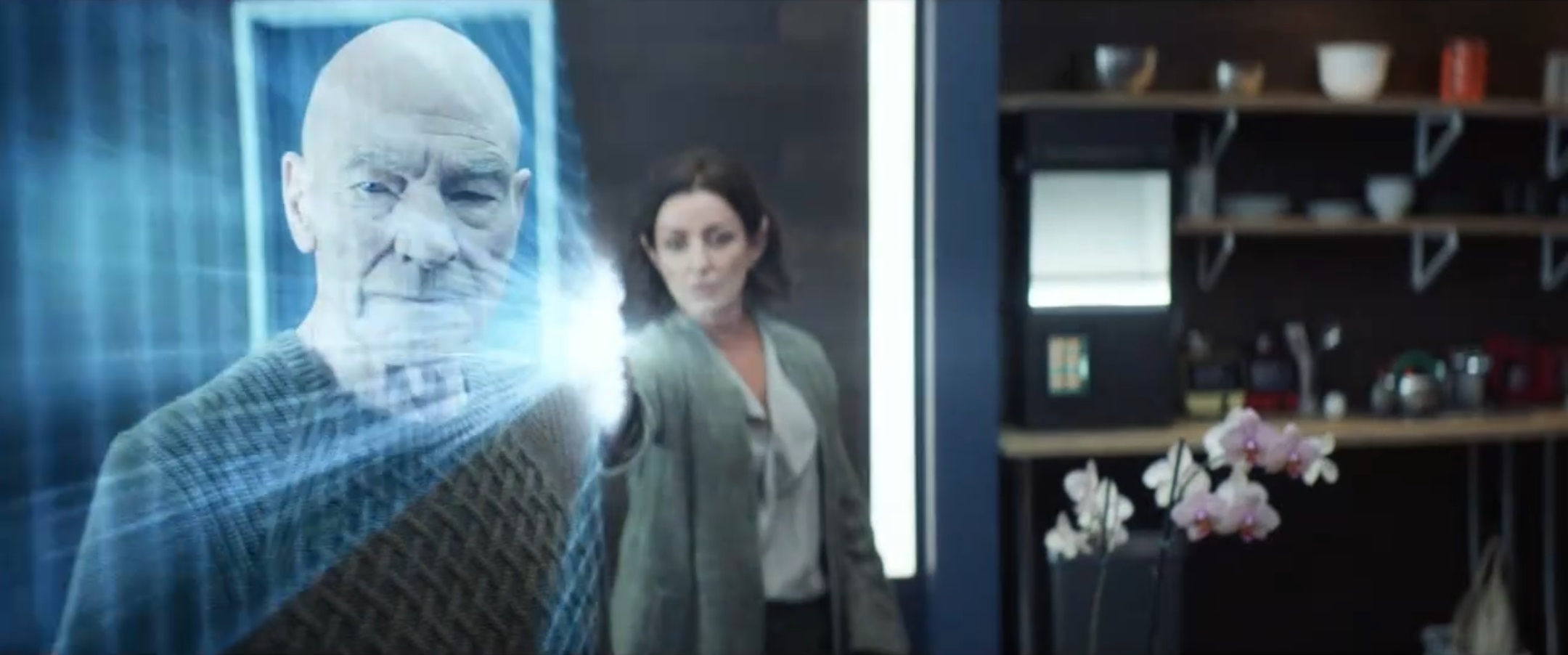
Data: The season opened with Picard dreaming of Data, and it closes with a fully conscious Picard speaking to Data thanks to a computer simulation. Brent Spiner's age is visible despite the best efforts of the makeup crew (and likely some CGI enhancement), but the scene is a nice touch, the two men speaking thoughtfully about the value of mortality. Though I wasn't particularly upset with Data's original sendoff, this quiet conversation, followed by a moment in which Data listens to Blue Skies (the song he sang at Riker's wedding) is a far more appropriate final bow for the character.

Dr. Soong: Data's curtain call does not spell the end of Spiner's Star Trek involvement, not so long as the Soong dynasty continues to have every male member look exactly like him. Alton Soong is appalled when he learns that Sutra helped Narek not only to escape, but to kill one of her own sisters to push the androids into sending the signal. "Turns out you're no better than we are," he says, the disappointment heavy in his voice. I hesitate to call this a redemption; Soong was entirely willing to commit genocide until he found out that his "children" are just as capable of selfishness and deception as all other sentient beings. He may end up being not quite a villain... but I find myself ultimately agreeing with Picard's assessment, when he states, "I don't much care for him."

Soji: Her encounter with Narek in the previous episode really should have been better written, as its apparent that their conversation in conjunction with Sutra's deception has pushed her into activating the signal.  She's the target of Picard's plea, and she is also the ultimate target of Oh's planned attack, meaning that the entire resolution revolves around her choice. Since we're never in doubt as to what she'll do, the stakes revolve more around the character than the plot. Unfortunately, in this episode, Soji feels more like a plot device than a person, leaving all of our character investment purely with Picard, which blunts the effectiveness of an otherwise generally well-executed climax.

Dr. Jurati: It turns out that she was lying when she pretended to be on the side of Sutra and Soong. When Soong congratulates her on the "sacrifice" she is willing to make as the androids' "mother," Jurati smiles and nods... until he leaves, when she spits out, "I'm not their mother, asshole." The endearing geek-girl side of her, seen in her Episode Three grin when Picard said, "Make it so," pops up again as she breaks Picard out, all the while amazed that no one has detected "the worst secret agent ever." Alison Pill, who's been too often pushed to the sidelines, seems to revel in her meatier role this episode. Still, I can't help but wonder at how all of her actions from the mid-season seem to be completely forgiven (even forgotten) by the ending scenes.

Narek: Thankfully, the one-dimensional pod-Narek of the previous episode is gone. Once he sees the transmitter, Narek is smart enough to go to the La Sirena crew to urge a truce to try to stop what is coming. Just as refreshingly, both Rios and Raffi are entirely willing to listen to him. They're wary, but they listen, and manage to form a plan to get back into the compound.

Seven of Nine: Her role in the finale is... underwhelming. I expected that she would be working to get the Borg's defenses back online to help in stopping the Romulans. This does not happen. Instead, Seven participates in the climax by getting into a fight with Narissa (who returns, both inexplicably and unnecessarily, after having been seemingly dispatched at the end of Broken Pieces). This entire bit feels like something spun out of whole cloth just to give Seven something to do. Much better is her final conversation with Rios, which reminds us that Jeri Ryan is actually a very good actress, something I hope Season Two makes better use of.

Oh, and perhaps following in the tradition of Voyager (which apparently ended with her in an inexplicable relationship with Chakotay), a shot near the end implies a new romantic relationship... with a character opposite whom she has barely shared screentime! I'll reserve judgement on this until I see it play out - but I can't help but wonder why this development wasn't saved for Season Two, when there might have been time to lay groundwork for it.


THOUGHTS:

"Fear is a poor teacher."
-Admiral Jean-Luc Picard, retired.

The entire crisis of Et in Arcadia Ego, and of Picard's first season in general, is because of fear. The Zhat Vash's entire existence traces back to fear of synthetics. That led them to sabotage Picard's rescue mission - of Romulus, no less - which in turn led to Starfleet banning synthetics... an overreaction born out of fear. Actions taken by both Starfleet and the Romulans have led the synthetics to feel backed into a corner, ready to lash out from fear of their own annihilation, in an attitude of "it's us or them"... a reaction that, as Picard observes, will make them into the very destroyers the Romulans have prophesied.

Picard has no capacity to go toe-to-toe with the Romulans, let alone the unknown synthetics. He has one ship against hundreds. Oh's initial reaction to La Sirena is to ignore it. Picard instead uses his wits to draw the Romulans' attention, all to delay the bombardment long enough to get Soji to listen as he pleads with her to make a better choice.

Related to the theme of fear throughout the season, we have also witnessed characters justifying their actions by claiming they have "no choice." Dr. Jurati felt she had no choice but to murder Bruce Maddox. The Zhat Vash insist they have no choice but to do whatever is necessary to stop the synthetics. Rios's former commander was ordered to commit murder, given no choice if he didn't want his own ship to be destroyed.

When Soji claims that she has no choice but to send the signal, Picard rejects that excuse. He labels it "a failure of imagination," and tells her that the decision to become the destroyer or not is what it has always been: Soji's decision and responsibility, and no one else's... in the process implicating every cry of "no choice" that has been heard throughout the show.

All of this works thematically, the refrains of fear and people feeling they have no choice having built throughout the season. It also works in terms of the story. As an episode, Et in Arcadia Ego, Part 2 builds effectively. Act One establishes the transmitter and the stakes. We then follow two groups - Narek and the La Sirena crew, Picard and Jurati - as they undertake separate actions to try to stop it. The final Act pays off the conflicting issues of the season - not only with the Romulans arriving, but with Picard trying to stop them with an appeal to reason and morality based largely on his own hope and faith in others... showing his own restoration, as such hope and faith would have been far beyond the broken man we saw in Remembrance.

For 45 of its 57 minutes, Et in Arcadia Ego, Part 2 stands as a strong season finale. Not everything works (the Narissa/Seven catfight is as poor as it is superfluous) and there's a bit too striking a resemblance between the glimpse we get of the Doomsday Synthetics and Babylon 5's Shadows (not quite enough to be a copyright infringement, but enough to make me skeptical of coincidence). Still, it's engaging and effective, with the quiet conversations between Rios and Seven, Elnor and Raffi, and finally Picard and Data all serving as an effective button...

And then the ending happens.

If you haven't seen the episode, then stop here, because I don't know how to discuss the ending without spoiling it...

A final conversation between old friends.

A MISJUDGED EPILOGUE

"A butterfly that lives forever is really not a butterfly at all."
-Data inadvertently sums up some of the problems with the ending.

Another theme the episode develops is the value of mortality. In the wonderfully effective Data cameo, Data makes a plea to have the matrix sustaining his intelligence shut down, so that he can experience a life that ends.

This fits with Picard's own arc. He has spent the entire season knowing that his time is short, that this will be his final mission. When he launches into orbit to face the Romulan fleet, he knows it is a one-way trip. He states that he is doing this to offer his life to Soji and her people, in hopes that they will see that they have options other than destruction. When he starts to collapse, he has Jurati inject him with stimulants that aggravate his condition, all so that he can remain alert to make his last appeal. To make his death mean something.

...And then they undermine that entire message by turning Jean-Luc into a frickin' robot!

Yes, Picard's consciousness is transferred into the synthetic "golem" that has been set up for the past two episodes. Even this isn't used effectively. This should frankly horrify him: His worst nightmare is being made into something other than human, as happened with the Borg. Instead, he's assured that everything is fine - He's basically entirely as he would have been minus the terminal illness, nullifying any chance of wringing anything more out of this late development. To all purposes, Picard having his brain put into a new body is nothing more than the most convoluted cure for a disease in recorded history.

This feels like a cheat, because it is a cheat.

Far, far better had the episode ended with Picard's death, with his consciousness fading during that conversation with Data and a tag featuring the other characters' reactions. But then I guess we couldn't have a Season Two. And what's thematic unity compared to keeping the cash cow pumping?


OVERALL:

For all that the ending leaves a bad taste in my mouth, I still have to give Et in Arcadia Ego, Part 2 a good score. For the bulk of its running time - and the entirety of the actual plot - it's highly engaging. The character dynamics are good, and the season's themes are effectively dramatized.

It's a shame about that epilogue, and I'd almost advise hitting "STOP" at the end of the scene with Data. Much like the season itself, however, the flaws of the episode - while evident - aren't enough to keep me from considering it a worthwhile addition overall.


Overall Rating: 7/10.

Previous Episode: Et in Arcadia Ego, Part 1
Next Episode: The Star Gazer

Season One Overview

Review Index

To receive new review updates, follow me:

On BlueSky:

On Threads:

Friday, June 24, 2022

1-09. Et in Arcadia Ego, Part 1

Sutra (Isa Briones) mind melds with Dr. Jurati to view The Admonition.

Original Air Date: Mar. 19, 2020. Written by: Michael Chabon, Ayelet Waldman. Directed by: Akiva Goldsman.


THE PLOT:

La Sirena's push through a transwarp conduit works: Picard and his team arrive at Soji's homeworld ahead of the Romulans... Well, most of them. Narek followed them through, and immediately attacks. Followed by Seven of Nine, in the commandeered Artifact.

The brewing space battle is interrupted by devices from the planet, which envelop all three vessels and bring them down to the surface. Narek is taken prisoner. Meanwhile, Seven works on repairing the Cube to defend against the oncoming Romulan fleet - which sensors show is made up of more than 200 warbirds!

Picard and Soji lead their team to Coppelius Station, which is populated by sentient androids, alongside their creator, Dr. Altan Inigo Soong (Brent Spiner). Picard warns them of the imminent attack and offers to evacuate them to safety. But Sutra (Isa Briones), a sister unit to Dahj and Soji, sees another alternative - one that could make the Romulan Admonition into a horrifying reality!


CHARACTERS:

Picard: The terminal illness he's been hiding is discovered after he collapses during the descent to the planet. He deals with this simply and brusquely, telling his crew that they are not to treat him as a dying man. Both Elnor and Raffi become emotional at different points in the show; Picard deals gracefully with Elnor, pointing out that one person never seeing the other again is a possibility any time two people part while also telling the young man how proud he is of him. He is more awkward with Raffi, clearly uncomfortable when she insists on physically embracing him.

Soji/Sutra: Isa Briones gets a dual role, and she does well with both parts. So well that I wish the producers hadn't insisted on making Sutra more visibly artificial with golden skin - Briones' performance does everything necessary to separate Soji and Sutra.  Sutra holds herself with perfect posture, speaking slowly and formally and without direct emotion, all of which shows that she's at a greater remove from the humans and other organics than Soji is or Dahj was. Meanwhile, Soji is an emotional mess. She confronts the captive Narek just to tell him how much she despises him, and later fumes that she should have killed him when she had the chance.

Dr. Jurati: The greater the remove from her exposure to The Admonition, the more she seems like the eager and likable young woman from the early episodes. She regards the androids with genuine awe. The only fear she shows is when Sutra asks to use a Vulcan mind meld to view The Admonition, and it's clear that she's frightened not of Sutra, but of revisiting that horrible vision. She feels tremendous guilt for her actions, making her perhaps a little too susceptible when Sutra and Soong offer her a chance to "make up for it."

Capt. Rios: When Sutra moves toward Jurati to perform the mind meld, he instinctively gets in the way. He steps aside after Jurati tells him that she's willing, but he still he remains close and wary, poised to act if needed. Before he and Raffi return to the ship, he shares a moment with Jurati when he makes clear that he retains strong feelings for her. He also tells her that he doesn't fully trust the synthetics, though she's too starstruck at seeing her lifelong dream made reality to pay much heed.

Narek: Returns to a significant role after being relegated to a nonspeaking cameo in Nepenthe and after sitting out Broken Pieces entirely. Unfortunately, the complex, conflicted man from the first half of the season has been replaced by a one-dimensional baddie. His conversation with Soji should see him torn by the divide between the personal feelings that we saw were genuine and his sense of duty, between guilt and what he sees as necessity. Instead, he ends up screaming threats about how the Romulans will wipe everyone out. I hope the finale restores a little bit of his previous character depth, because this pod-Narek is just plain boring.

Seven of Nine: While connected to the Borg, her perceptions widened. She "saw" Picard use the transwarp conduit to reach this planet, then followed to lend aid. Yes, it's a bit of Borg-ex-machina, but that was hardly unheard-of on Voyager either. She and Elnor are firmly united in protecting the surviving ex-Borg, but she shows genuine respect and even deference to Picard in their scene together.

Dr. Soong: Brent Spiner returns, free of his Data makeup, as Altan Inigo Soong, son of Data's creator. He shows a hint of resentment about his father, indicating that the late Dr. Soong valued Data over his own child; still, he also seems to regard the androids as his children, and seems willing to protect them even at the cost of human lives. Spiner is good in the role, creating a character who may physically resemble Data ("if he'd gotten old and gone soft"), but who is very different than the android in temperament.


THE PICARD SLEDGE-HAMMER:

Though we've gotten a few Picard speeches during this season, notably when he tried to talk Seven out of seeking vengeance, this is the first episode that really brings out his full range of rhetorical moralizing.

First he tries to defuse Soji's anger after she confronts Narek. She muses about "the logic of sacrifice." Picard at least temporarily steers her away from that train of thought by pointing out that such logic "depends on if you're the person holding the knife." He's less successful with Sutra and Soong. He calls on the androids to remain peaceful and patient, promising that he will advocate on their behalf to Starfleet... a promise Soong punctures by pointing out that Starfleet didn't listen to Picard when the synthetic ban was put into effect, and that there's no reason to believe that they will listen to him now.


THOUGHTS:

Et in Arcadia Ego, Part 1 does exactly what it needs to do. Pieces are put in place for the finale, with the regulars all on the same planet. Stakes are raised: A Romulan fleet is soon to arrive. Complications are introduced that pay off elements from earlier in the season while furthering the crisis for the final episode.

There are also several fine character moments. Each regular gets at least one good scene: Elnor's brief but heartfelt talk with Picard; Raffi's emotional reaction to Picard's illness; an early exchange in which Soji indulges Raffi in her paranoia about "homicidal fungus"; and even Picard's nonverbal reaction to an ex-Borg calling him "Locutus." The script may be focused on putting the plot pieces into place, but it doesn't forget the characters.

With one exception: Narek. Earlier episodes showed him to be smart, patient, and a master at connecting to people. None of those traits are in evidence here. He is captured offscreen, apparently without effort. His scene with Soji is the worst-written in the episode, carrying none of the emotional dynamics that are called for. His interaction with Sutra is entirely one-sided, the once-calculating spy never even thinking to probe at her motivations.  Finally, the episode ends with his status having shifted too abruptly... and once again, with key moments occurring offscreen. It's as if the writers knew that they should do something with him, but didn't know exactly what, and this strand throws the final part of this episode off-balance.


OVERALL:

The last ten minutes feels oddly rushed, in no small part due to the perfunctory treatment of the Narek subplot, which blunts the effectiveness of this otherwise well-made installment. Et in Arcadia Ego, Part 1 mostly does its job of putting plot pieces in place for the finale while still grounding itself in character moments. But the abrupt ending leaves a mixed final impression.


Overall Rating: 6/10.

Previous Episode: Broken Pieces
Next Episode: Et in Arcadia Ego, Part 2

Review Index

To receive new review updates, follow me:

On BlueSky:

On Threads:

Monday, May 2, 2022

1-06. The Impossible Box.

Narek guides Soji through a forbidden ritual.

Original Air Date: Feb. 27, 2020. Written by: Nick Zayas. Directed by: Maja Vrvilo.


THE PLOT:

Bruce Maddox is dead... but not before telling Picard that Soji is on the Artifact, working for the Borg Reclamation Project. That means a new course: into Romulan territory, in violation of the treaty between the Romulans and the Federation. This doesn't worry Picard, who has a plan to sidestep that. But voluntarily going to a Borg Cube brings back the worst memories of his life.

On the cube, Soji is having nightmares. A few questions from Narek lead her to question her own past and memories. Narek offers a solution in the form of the Zhal Makh, a Romulan meditation ritual that is forbidden to outsiders. Soji feels just desperate and vulnerable enough to agree, not realizing that she could be walking into a trap.


CHARACTERS:

Picard: Even the prospect of returning to a Borg cube puts him on edge, and when he beams over, he all but collapses at the memories of being transformed into Locutus of Borg. He is impressed by the work the Reclamation Project is doing under Hugh's direction, amazed to see the Borg assimilation reversed on such a scale. When Hugh protests that the results are far from ideal, Picard dismisses that: "What you're doing is good, Hugh. There's no need for it to be perfect."

Soji: Narek's questions already have planted doubts, which may well be what prompted her nightmares in the first place. When Narek tells her that the logs of her calls to her mother all last a mere 70 seconds, she investigates on her own, scanning her old photos and childhood mementos. She is understandably shocked when every item reads as "37 months old." All of this leaves her vulnerable to Narek's suggestions, even though she still doesn't truly trust him.

Dr. Jurati: "I have a superpower: I can sense mistakes while I'm making them." Jurati has been left shaken by Maddox's death. She seeks comfort by initiating an affair with Capt. Rios, even though she pauses to label this a mistake before going forward with it. She continues to be refreshingly eager to avoid danger: She hates space travel, in part because space "wants to kill you," and she is openly relieved when Picard is the only one allowed to beam over to the cube.

Narek: The episode's title refers in part to Narek's prized possession: a puzzle box that his sister dismisses as a "toy." Narek clarifies that it's a tool that helps him focus, as solving the box requires patience. He compares the box to Soji: "The information is all in there... The key to opening (the box) is taking the time to understand what's keeping it closed." Despite his cold words, it's obvious that he's emotionally attached to Soji. When his trap for her finally snaps shut, his face is the very picture of anguish.

Elnor: The sheltered Romulan is fast becoming one of my favorite characters. Some comedy is wrung from his blunt assessments of both Picard and Jurati, with him worrying that he was "in-butting" after seeing their reactions. He is highly observant and is the first to notice that Jurati is feeling haunted. His pledge to Picard makes him resist staying on the ship, and Picard has to firmly order him to stay behind before he will agree.

Raffi: Her son's rejection sees her returning to her worst habits. She's drinking almost constantly, and she apparently picked up some of her favorite recreational drug while on Freecloud, leaving her in a bad state. Rios acts as a friend, making sure to be there for her without trying to push her or lecture her. To her credit, she pulls herself together long enough to prod a Starfleet contact into getting Picard authorized for a visit to the Artifact - but even this moment of usefulness comes at a price, as the old friend she calls tells her to never call again, leaving her shaken as she staggers off the bridge.

Hugh: He makes sure to greet Picard on beam-in, recognizing how traumatic this visit will be for the former Starfleet officer. Though he appreciates Picard's praise for his work, he isn't entirely happy with the way the Romulans are running the project. His team may be able to deprogram the Borg drones, but the Romulans won't allow the ex-Borg to leave, leading him to complain that they have exchanged slavery to the Borg for slavery to the Romulans. It's unspoken but obvious that he accepted the post to make sure no actual abuses take place. He is unsurprised when Picard asks about Soji, not least because he has observed Narek's interest in her and has already realized that she is in trouble.


THOUGHTS:

I have been waiting for this.

So far I've been enjoying Picard. Episode by episode, it's been consistently decent, consistently enjoyably, consistently fine. Just fine. I've found something to enjoy in every episode; but of the first five installments, only Map and Legends left me genuinely gripped.  The rest have left me generally entertained, but not much more than that.

The Impossible Box finally delivers. Part of the reason, I think, is that it runs 54 minutes - about ten minutes longer than most episodes - giving the story time to breathe. Though it's a major arc episode, Nick Zayas's script focuses heavily on the characters. Every one of the regulars receives at least one good scene, and the characters feel like complete, flawed, messy human beings.

There are a number of strong moments. The scene in which Raffi gains Picard's authorization is an old-fashioned bit designed to make you laugh and smile at the victory... until Raffi gets a verbal slap as an old friend tells her never to call again. I found the scene of Picard's traumatic arrival on the Borg to be over-the-top, but it's thankfully a brief moment; and the tone instantly corrects when Hugh arrives. This single misjudged scene is then followed by a quite good one, as Hugh takes time to show off the work that is being done to reclaim the ex-Borg. This allows Picard to recognize that his former tormenters are themselves victims, and the work Hugh is doing to try to save them seems to bring Picard a measure of peace.

The best scene is the major set piece, as Narek takes Soji through the Zhal Makh. This is staged as Soji taking a physical journey to match her emotional one. Her path is marked out by candles, with her slowly moving along this path as she mentally relives her nightmare. When her internal defenses kick in to try to make her stop, Narek is ready. He is soft and affectionate in his manner, but his every breath is spent urging her to search for the answers that he needs as much as she does, even though doing this causes him genuine emotional pain. In short, the scene is an encapsulation of their entire relationship.

It ends with an effective action sequence, with its final fade-out clearly a direct lead-in to the next episode. As we go to black in mid-confrontation, a final line is spoken, followed by the sounds of combat. Given the last time we heard that line, there's not much doubt about what happens next... but the execution is perfectly judged, as much for the gap between dialogue and sound effects as for the actual writing.

As the end credits started to roll, I had to restrain myself from moving onto the next episode - marking only the second time that an episode has left me with that reaction.


OVERALL:

The Impossible Box is easily the best episode of Picard up to this point. An extra ten minutes of running time gives it space to breathe. Every one of the regulars receives at least one good moment, and the script doesn't so much balance character and plot advancement as intertwine them, with the big story scenes also being big character scenes.

I'm not quite awarding full marks; I didn't care for the overdone moment when Picard arrived on the Cube, which led me to wonder how he was even able to function during other post-Best of Both Worlds encounters with the Borg. Still, this was an otherwise terrific episode, and I'm hoping it marks a turning point in a series that, while perfectly entertaining, has until this point mostly fallen short of its potential.


Overall Rating: 9/10.

Previous Episode: Stardust City Rag
Next Episode: Nepenthe

Review Index

To receive new review updates, follow me:

On BlueSky:

On Threads:

Saturday, March 19, 2022

1-02. Maps and Legends.

Picard and Laris search Dahj's apartment for traces of her attackers.

Original Air Date: Jan. 30, 2020. Written by: Michael Chabon, Akiva Goldsman. Directed by: Hanelle M. Culpepper.


THE PLOT:

Dahj (Isa Briones) is dead, killed in front of Picard's eyes by Romulan agents. Killed while trying to save him, even though he was meant to protect her.

With few immediate leads to act on, Picard and Laris (Orla Brady) - his housekeeper, also a former member of Romulan intelligence - investigate Dahj's apartment. It's been wiped clean, but Laris finds a few traces of Dahj's sister. Not enough to locate her, but enough to show that she is not on Earth.

Soji (Isa Briones) is a scientist working at the Borg Reclamation Project, a Romulan-controlled facility operating out of an abandoned Borg Cube. Soji's focus is on the removal of implants from Borg drones. She takes her work seriously, regarding it as a duty to free them... but off-hours she is quite playful with her new lover, Narek (Harry Treadaway), a recent arrival who keeps himself shrouded in secrecy.

Meanwhile, Laris informs Picard of the existence of the Zhat Vash, the unofficial, supposedly mythical organization behind Romulan Intelligence organization. The "scrubbing" of Dahj's home leads Laris to believe the Zhat Vash is not only real, but active on Earth. And if Dahj has a sister, that means that the Romulans' work is far from over!


CHARACTERS:

Picard: His on-air denunciation of Starfleet comes back to bite him when he tries to request a ship from Admiral Clancy (Ann Magnuson). Clancy is dumbstruck at the "sheer f***ing hubris" of Picard to ask for favors after shaming Starfleet on interstellar television, and all but tells him to go rot in his decrepitude. Picard, not deterred, draws on other contacts to get into space. When it's pointed out that he will need a crew, he waves off the suggestion of his old shipmates. Data died to save him, and he's been haunted by that for twenty years; he won't put any of his old friends in a similar situation if he can help it.

Soji: The script takes care to make her instantly likeable. When she sees new arrival NaƔshala (Chelsea Harris) worrying about working on the Borg Cube, she puts her at ease with reassuring comments and makes sure to keep close during the woman's first day. She also teases Narek for his secrecy in a way that's endearing without seeming mean. Basically, the episode makes sure to make us invested in her well-being so that we'll care when the plot catches up to her.

Narek: Is so obviously a spy that it would have been more surprising if he hadn't turned out to be one. He's on the Cube to draw information from Soji, which he believes is best done with a gentle touch, and he's not above enjoying his work. He is displeased when he's advised that he needs to get results soon, however - and even more displeased when he's not-so-subtly threatened.

Laris: Thus far, I am absolutely loving Orla Brady's Laris. There are shades of DS9's Garak in the character: a former spy now engaged in a seemingly benign job. She isn't a female Garak clone, though. Garak was cold and calculating; Laris is warm and fiercely protective of Picard. Both fence with their Federation counterparts with humor, but Laris's banter is more friendly, even flirtatious. Though she proclaims Picard's plans to return to space are madness, you can see that she enjoys investigating Dahj's apartment and uncovering secrets, as if she's coming a little more to life herself in doing so.

Pompous Earth Bureaucrat of the Week: Admiral Clancy, presented as the soulless face of a Starfleet that has lost its way. She not only refuses Picard's request, but seems to take pleasure in belittling him. Her attitude aligns with that of the previous episode's interviewer: that the Romulans were their enemies and should have ben left to die.  When Picard protests, she directly states that the Federation "absolutely" gets to decide if other species live or die. She tells him that Starfleet "is no longer (his) house... go home," brushing aside his warnings of a larger plot as the ravings of an old man who is "desperate to matter."


THOUGHTS:

"Before the Tal Shiar, there was the Zhat Vash... a term sometimes used to refer to the dead, the only reliable keepers of secrets... That's the sole purpose of the Zhat Vash: To keep a secret so profound and terrible just learning it can break a person's mind.
-Laris fills Picard (and audience) in on the apparent villains of the season.

Maps and Legends opens with a flashback. Remembrance told us about the synthetic uprising on Mars that so changed both Starfleet and Picard. This episode shows it, and does so from the point of view of one of the synthetics that went rogue. We follow F8 (Alex Diehl) through the start of a work shift. He is mocked by the humans he interacts with, but shows no reaction... until one of his eyes changes slightly, at which point he begins reprogramming planetary defenses (and as you may recall from Brothers, androids reprogram computers very quickly). He kills the humans who are present, turns the defenses to fire on the planet itself, and ends by shooting himself.  It's an effective opening hook, one that brings to life events previously just told to us, and that strongly hints that the uprising was not an AI rebellion so much as the result of outside sabotage.

Maps and Legends advances the overall story considerably, giving us more information about the group that attacked Dahj and now watches Soji, while also bringing Picard closer to the main action. It's a considerably better-paced episode than Remembrance, and it handles its exposition more dynamically.  Laris's infodump about the Zhat Vash is intercut with her and Picard investigating, for example, so that the information is imparted even as we see Picard working for it.

This episode builds both the characters of Picard and Soji, the two central figures whose paths are beginning to intersect. Picard is an old man, seen by many as a relic and even referred to at one point as "The Hermit of La Barre." Soji is a vital young woman, doing what she sees as important work and freely and happily interacting with others. They are two very different individuals at very different points in their lives, and in the normal course of events they would never meet unless she was attending one of his lectures.

But they are both bound up in the same conspiracy: Soji as its apparent target, Picard because of the connection to his past. To Picard, failing to save Dahj was like failing to save Data all over again - all the more so because Dahj, like Data, died protecting him. Thus far, the conspirators aren't taking him seriously; like the interviewer, and like Admiral Clancy, they see him as a feeble old man who has spent the past decade "mothballed on that vineyard of his." Still, his doctor (David Paymer) confirms that he has no diminished capacity. He has health issues, including one very serious one - but his cognitive ability is "at or above Starfleet minimums," and his doctor states that "for a relic, (he's) in excellent shape."


OVERALL:

Right now, the threads of the plot are still being woven, and characters are still being established. That said, Maps and Legends is a good second episode, building on the foundations set by the premiere while improving on its execution. 

Hopefully, the payoff will match the setup. Regardless, this is a good episode on its own terms, one that leaves me actively wanting to move forward to the next installment.


Overall Rating: 8/10.

Previous Episode: Remembrance
Next Episode: The End Is the Beginning

Review Index

To receive new review updates, follow me:

On BlueSky:

On Threads: